AI Toothbrush: The Quiet Tech Revolution Happening in Your Bathroom
Inside the AI Toothbrush Boom: How a $2 Billion Market Is Reshaping Oral Care
As Dyson enters the category with a camera-equipped model, the AI toothbrush is shifting from a novelty gadget to a genuine health-monitoring device.
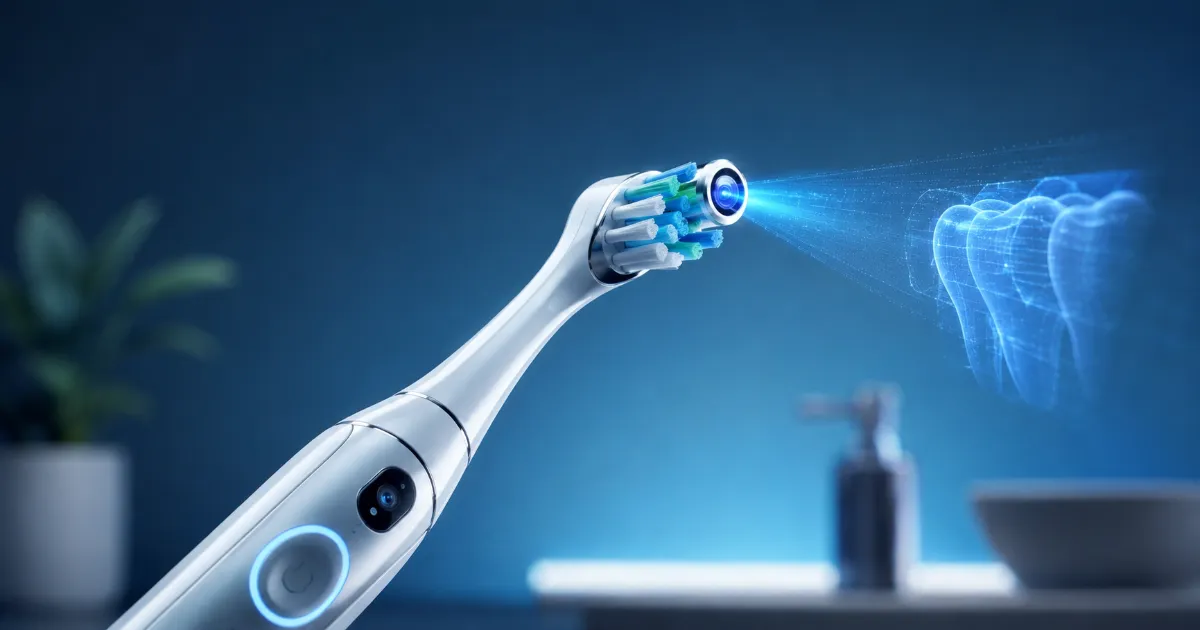
On September 1, 2026, in Paris, James Dyson stood in front of a room of journalists and unveiled something that would have sounded absurd a decade ago: a toothbrush with a camera inside it. The Dyson CameraJet, priced at $499, packs a 100,000-pixel macro lens into a brush head roughly the size of a pencil tip, capturing 28 images per second and running them through an AI model trained on 470,000 dental images to locate the gaps between teeth in real time — then firing a precision jet of mouth rinse directly into them. It took six years, 661 engineers, and 38 patents to build, according to the company.
The CameraJet isn’t the first AI toothbrush, and it won’t be the last. But its launch is a useful marker for just how far this category has traveled — and how much further the underlying market believes it’s going. According to market research firm The Business Research Company, the global AI toothbrush market grew from $2.11 billion in 2025 to an estimated $2.41 billion in 2026, and is projected to nearly double to $4.09 billion by 2030, a compound annual growth rate of 14.1%. This is no longer a niche category chasing early adopters — it’s one of the fastest-growing subsegments in all of consumer health technology, and it’s worth understanding why.
Tech Gifts Under $50: The Ultimate 2026 Gift Guide for Anyone
Refurbished Phones in 2026: Save Big or Regret It?
How We Got Here: From Bluetooth Timers to Real-Time Diagnostics
The definition of a “smart toothbrush” has shifted dramatically in a short period. The earliest connected models did little more than pair with a phone via Bluetooth and track brushing duration — useful for building a habit, but hardly intelligent. What’s changed since is the convergence of three separate technology curves: sensor costs have fallen sharply, Bluetooth Low Energy connectivity has matured into a reliable, low-power standard, and AI models capable of running meaningful analysis have become both more sophisticated and cheap enough to embed in a consumer device that costs under $50 in some cases, and up to $500 at the premium end.
That convergence has produced a genuinely different category of product. Oclean’s X Ultra Wi-Fi Smart Sonic Toothbrush, for instance, uses a patented real-time AI voice guide delivered through bone conduction, coaching users on brushing pressure, speed, and area coverage as they brush, with no need to check a phone screen mid-routine. Philips Sonicare has continued expanding its sensor-driven feedback systems across newer product ranges, while India-based Oracura launched an app-connected smart toothbrush in December 2025 specifically targeting the country’s fast-growing demand for data-driven oral care. Across the category, brands report that modern AI-powered electric toothbrushes can now track brushing pressure, technique, and coverage area with accuracy approaching 98%, according to industry analysis from Intel Market Research.
The Dyson CameraJet represents the next logical step in that progression: rather than inferring brushing quality from motion sensors and pressure data alone, it adds direct optical verification — the toothbrush can now literally see what it’s cleaning.
What’s Actually Inside These Devices
It’s worth unpacking what “AI” means in this context, because the term gets applied loosely across the category. At the more basic end, AI toothbrushes use accelerometer and gyroscope data to infer brushing motion, pattern-match that motion against a trained model of “ideal” brushing technique, and generate feedback — too much pressure, missed quadrant, brushing too fast. This is the foundation most smart toothbrushes on the market are built on, and it’s already meaningfully more sophisticated than a simple two-minute timer.
The CameraJet’s Gap Optical Targeting system operates on a different technical layer entirely. Its 100k-pixel macro lens, paired with a built-in light source, captures continuous live video of the tooth surface as the brush moves. A machine learning model — the 470,000-image training set Dyson has cited — analyzes each frame in roughly 100 milliseconds to identify interdental gaps, the specific spaces between teeth where plaque and food debris accumulate first and most persistently. Because there’s a slight physical delay between detection and the jet firing while the user’s hand keeps moving, the system also has to predict where a gap will be a fraction of a second later, rather than simply reacting to where it currently sees one — a genuinely nontrivial computer vision problem for a device this small and this cheap to manufacture at scale.
Notably, Dyson has built privacy directly into the system’s architecture: according to the company, no images are recorded or stored either on the device or in the cloud, addressing one of the more obvious concerns that comes with putting an internet-connected camera inside someone’s mouth.
The Industry Impact: Why Every Major Player Is Racing Into This Space
For an industry as old and unglamorous as toothbrush manufacturing, the pace of investment right now is striking. Leading brands are collectively investing more than $200 million annually in AI dental technology research and development, according to Intel Market Research’s industry tracking. Philips and Procter & Gamble — both legacy players in oral care — have significantly expanded Bluetooth connectivity and companion-app features across recent product lines specifically to compete in the AI-enabled segment, rather than treating it as a premium add-on.
Geographically, adoption is uneven but instructive. North America currently leads with roughly 40% of smart toothbrush market share, driven by an existing fitness-tracking culture and high consumer awareness of the connection between oral health and broader systemic health outcomes. Europe follows at around 35% market share, propelled by strong dental-professional endorsement of connected brushing tools and GDPR-compliant data handling standards that have made European consumers comparatively more comfortable trusting these devices with personal health data.
The manufacturing side of the industry has also had to adapt quickly. What used to be a relatively simple hardware category — motor, bristles, battery — now requires precision sensor integration, embedded machine learning capability, wireless connectivity stacks, and increasingly, cloud infrastructure to support companion apps and longitudinal data tracking. For OEM suppliers, smart toothbrushes now represent the highest-growth subcategory within the entire oral care manufacturing sector, forcing a level of engineering sophistication the category has never previously required.
The Human Impact: What Changes for the Person Brushing Their Teeth
Strip away the market-sizing statistics, and the more interesting question is what this technology actually changes for an ordinary person standing at a bathroom sink. The honest answer is that it changes behavior more than it changes brushing mechanics — and behavior change is precisely where most people’s oral hygiene routines fall short.
Real-time feedback is the core mechanism at work. A brush that tells you, mid-stroke, that you’re applying too much pressure or have missed the back molars corrects a habit in the exact moment it’s happening, rather than relying on a dentist pointing it out during a checkup six months later — by which point the habit is deeply ingrained and the damage, in the form of gum recession or enamel wear, may already be underway. Industry surveys suggest more than 65% of consumers are now actively seeking smart dental solutions specifically because of this kind of real-time accountability, and adoption rates for AI-powered toothbrushes have risen roughly 40% over the past two years as that awareness has spread.
There’s also a psychological dimension that shouldn’t be underestimated. Forbes’ hands-on account of the CameraJet framed this plainly: a device that can visually confirm you’ve actually reached every gap between your teeth removes the ambiguity that makes flossing one of the most commonly skipped parts of an oral hygiene routine. Most people don’t skip flossing because they don’t understand its importance — they skip it because it’s fiddly, easy to do poorly, and easy to convince yourself you’ve “basically” done. A tool that closes that gap between intention and actual, verified execution addresses a behavioral problem, not just a technical one.
For children, several brands have leaned into gamification — turning brushing technique into a game with visual rewards for full coverage — which early data suggests meaningfully improves both duration and thoroughness among younger users who otherwise treat brushing as a chore to rush through. For elderly users or those with limited dexterity, motion-guidance feedback can help compensate for reduced fine motor control, a use case that’s likely to become more prominent as the technology matures and prices come down toward mass-market accessibility.
The Health System Angle: Where This Gets More Interesting
The more significant long-term implication may not be in individual bathrooms at all, but in how this data connects to the broader healthcare system. Oral health has an increasingly well-documented relationship with systemic conditions — periodontal disease has been linked in research to cardiovascular disease, diabetes complications, and even certain pregnancy outcomes. A toothbrush capable of tracking brushing consistency, technique, and even early visual signs of gum inflammation over months or years generates exactly the kind of longitudinal behavioral data that preventive medicine has historically struggled to capture.
Some brands are already building toward this future through subscription-based oral care services that combine hardware with ongoing data analysis and personalized coaching, rather than treating the toothbrush as a one-time purchase. Teledentistry integration — where a dentist could review a patient’s brushing data or even flagged visual anomalies between in-person visits — remains an emerging rather than mainstream capability across the category today, but it’s a logical next step given the direction the underlying sensor and camera technology is already heading.
The Honest Limitations
None of this should be mistaken for AI toothbrushes replacing professional dental care, and it’s worth being direct about the limits of the current technology. Cavity and gum disease detection through a consumer toothbrush camera remains fundamentally different from a clinical dental exam — these devices are built to guide brushing technique and interdental cleaning, not to diagnose disease, and no reputable manufacturer in this space claims otherwise. Price also remains a real barrier to the category’s more advanced end: at $499, the CameraJet sits well outside impulse-purchase territory, and meaningful mass-market adoption of camera-equipped models will likely depend on the same cost curve that brought basic Bluetooth-connected brushes down from luxury pricing to sub-$50 territory over the past several years.
There’s also a legitimate data-privacy conversation the industry will need to keep having as these devices become more capable. Dyson’s decision to process camera data entirely on-device without cloud storage is a notable design choice precisely because it isn’t yet the industry default, and as more brands add cameras and biometric sensors to products that sit inside people’s mouths twice a day, consumer trust will depend on that kind of privacy-by-design approach becoming standard rather than exceptional.
What Comes Next: The Road to a Full Dental Ecosystem
The CameraJet’s launch alongside a companion Dyson Toothpaste and Dyson Mouthrinse — both reformulated specifically to avoid obstructing the camera’s view, with the toothpaste dropping the common foaming agent sodium lauryl sulfate — signals something beyond a single product launch. It points toward brands building complete oral care ecosystems rather than standalone devices, mirroring the same playbook consumer tech companies have used for years in categories from razors to coffee machines: sell the hardware, then build a recurring, higher-margin consumption layer around it. Dyson has been explicit that this is only the beginning of a broader dental system, and competitors are unlikely to sit still while a premium new entrant redefines what “oral care” can mean as a product category.
That trajectory also raises a genuinely open question for the years ahead: how much of what a dentist currently checks for at a routine cleaning could eventually be monitored continuously, at home, by the toothbrush itself? Full clinical-grade diagnostic capability remains a meaningful technical and regulatory distance away — consumer devices aren’t held to the same accuracy or approval standards as clinical equipment, and manufacturers are careful not to blur that line. But the direction of travel, from motion sensors to real-time optical analysis in under a decade, suggests the gap between “smart toothbrush” and “home diagnostic device” is narrowing faster than most people outside the industry currently realize.
The Verdict
The AI toothbrush category has crossed a genuine threshold in 2026, moving from motion-tracking novelty to something closer to a real diagnostic and behavioral tool — and the launch of a camera-equipped model from a brand with Dyson’s engineering reputation is likely to accelerate that shift further, both by legitimizing the category to a broader premium consumer base and by pressuring competitors to close the technical gap. The $4.09 billion market projected for 2030 reflects genuine underlying demand rather than pure hype: real-time feedback measurably changes brushing behavior, and behavior — more than any single piece of hardware — is what determines long-term oral health outcomes. Whether every household needs a $500 toothbrush with a camera inside it is a separate question from whether the underlying technology represents real progress. On the evidence so far, it does.
Messi Retires from Argentina, Legend Ends 21-Year International Career
One Comment