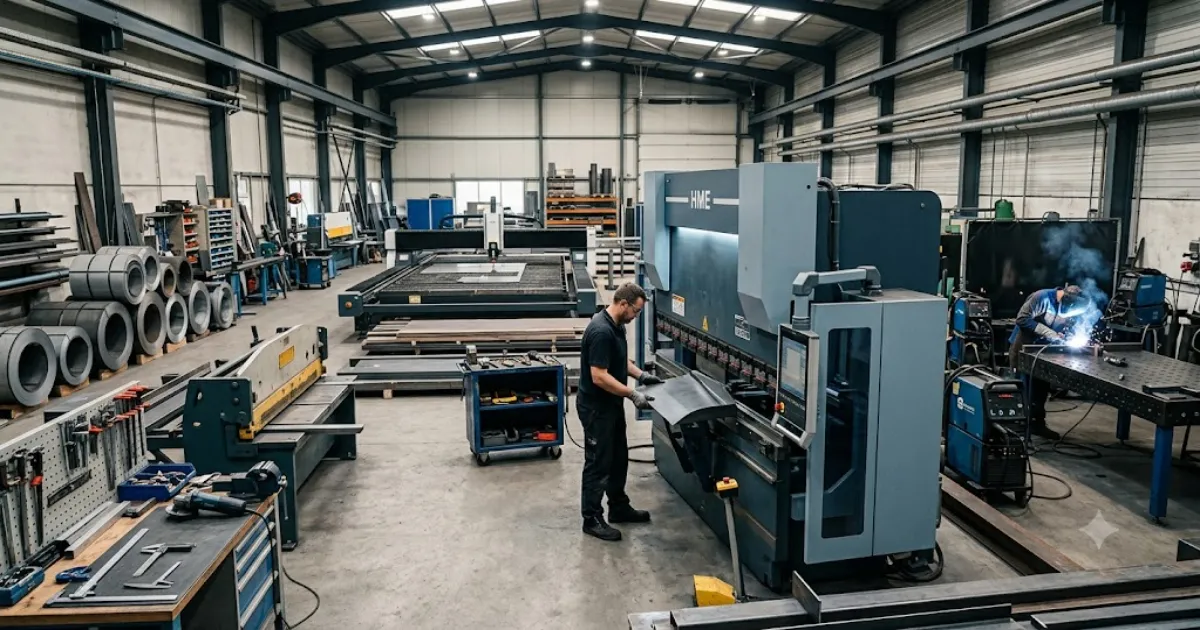
Sheet Metal Fabrication Tools Explained: A Complete Guide to Essential Equipment
From measuring and cutting to bending, forming, welding, and finishing, Sheet Metal Fabrication Tools Explained helps you understand the equipment behind every stage of metalworking.
Sheet metal fabrication is one of the most important processes in modern manufacturing, construction, automotive production, aerospace, HVAC systems, industrial machinery, and countless other industries. From a simple metal bracket to a complex machine enclosure, almost every fabricated metal product begins with raw sheet material that must be measured, cut, shaped, joined, and finished. The quality of the final product depends not only on the skill of the fabricator but also on selecting the right equipment for every stage of the process. This guide to Sheet Metal Fabrication Tools Explained covers the essential hand tools, cutting machines, bending equipment, forming tools, welding systems, and finishing equipment used to transform flat metal sheets into finished products.
Understanding these tools is useful for beginners entering the metalworking industry, workshop owners planning to upgrade their equipment, students learning manufacturing processes, and businesses looking to improve production efficiency. Some tools are simple and manually operated, while others use hydraulic systems, computer numerical control, lasers, plasma technology, and automated software. Regardless of the level of technology involved, each tool performs a specific function in the fabrication process.
AI Toothbrush: The Quiet Tech Revolution Happening in Your Bathroom
Tech Gifts Under $50: The Ultimate 2026 Gift Guide for Anyone
The basic journey of sheet metal fabrication usually begins with planning and measurement. The material is then marked according to the required dimensions before cutting takes place. After the pieces are cut, they may be bent, rolled, punched, drilled, or otherwise formed into the desired shape. Separate pieces can then be joined through welding, fastening, or other methods. Finally, the fabricated product may go through grinding, polishing, coating, painting, or another finishing process.
Understanding the Role of Tools in Sheet Metal Fabrication
Sheet metal fabrication is not a single manufacturing operation. It is a collection of processes that work together to create a finished component. A workshop producing custom metal cabinets may require different equipment from a facility manufacturing automotive body panels. Similarly, an HVAC fabricator working with thin galvanized steel may use different tools from an industrial company processing thick stainless steel or aluminum.
Choosing the right tool depends on several important factors, including the type of metal, material thickness, production volume, required accuracy, part complexity, available budget, and desired surface finish. A small workshop producing custom parts may rely heavily on manual tools because they provide flexibility and require lower initial investment. A large manufacturing facility, however, may use CNC laser cutters, automated press brakes, robotic welding systems, and computer-controlled finishing equipment to produce thousands of identical parts.
For this reason, learning about sheet metal tools is not simply about knowing their names. It is about understanding where each tool fits within the production workflow and what advantages it offers.
Measuring and Marking Tools
Accurate measurement is the foundation of successful fabrication. Even the most advanced cutting or bending machine cannot correct a design that was measured incorrectly. Measuring and marking tools are therefore among the first pieces of equipment used in almost every fabrication project.
A steel ruler is one of the simplest and most common measuring tools. It is useful for measuring short distances, checking dimensions, and marking straight lines. Longer projects may require measuring tapes, especially when working with large sheets or fabricated assemblies.
Vernier calipers and digital calipers provide greater precision. These tools can measure external dimensions, internal dimensions, and material thickness. They are particularly useful when fabricators need to work within tight tolerances. Micrometers can provide even greater accuracy and are commonly used when precise thickness measurements are required.
A combination square is another valuable workshop tool. It can be used to measure angles, check whether edges are square, and create accurate layout lines. Engineers and fabricators may also use protractors, angle gauges, and digital angle finders when a project involves complex bends or angled cuts.
Marking tools include scribers, markers, layout fluid, center punches, and soapstone. A scribe creates a fine line directly on the metal surface, while a center punch creates a small indentation that helps guide a drill bit and prevents it from moving across the material.
Accurate marking reduces waste and helps ensure that cutting and forming operations begin in the correct location. In high-volume manufacturing, manual marking may be replaced by automated positioning systems and CNC programming, but the principles of accurate measurement remain the same.
Sheet Metal Cutting Tools
Cutting is one of the most important stages of fabrication. The type of cutting tool required depends largely on the thickness and type of material, as well as the shape and accuracy required.
Hand-operated snips are among the most basic sheet metal cutting tools. Aviation snips, also known as compound action snips, are commonly used to cut thin sheet metal. Different snips are designed for straight cuts, left-hand curves, and right-hand curves. These tools are inexpensive, portable, and useful for small projects, repair work, and detailed cutting.
Bench shears provide greater cutting capacity than hand snips. A sheet metal shear uses a long blade to produce straight cuts through metal sheets. Manual versions are suitable for smaller workshops, while hydraulic and powered shears are used in industrial production.
Guillotine shears are designed for cutting larger sheets quickly and accurately. The metal is positioned beneath a blade, which moves downward to create a straight cut. Modern industrial shearing machines can be equipped with back gauges and programmable controls to improve repeatability.
A jigsaw fitted with a suitable metal-cutting blade can also be useful for creating curved or irregular shapes. Nibblers are another option for cutting complex patterns and curves. A nibbler removes small pieces of material as it moves, allowing the operator to create shapes that would be difficult to produce with a straight-blade shear.
For heavier-duty work, power saws and abrasive cutting machines may be used. However, advanced fabrication facilities increasingly rely on laser and plasma cutting technology.
Laser Cutting Machines
Laser cutting has transformed modern sheet metal manufacturing. A laser cutter uses a highly concentrated beam of energy to melt or vaporize material along a programmed cutting path. CNC technology controls the movement of the cutting head, allowing manufacturers to produce highly accurate and complex shapes.
Laser cutting offers several important advantages. It provides excellent precision, can produce intricate designs, reduces the need for manual layout work, and can process large quantities of identical parts. Modern fiber laser systems are especially popular because they can cut many types of metal efficiently.
Another benefit is the reduction in physical tooling. Traditional punching and stamping operations may require dedicated dies for different shapes. A laser cutter can create different patterns by simply changing the digital program.
Laser cutting is particularly useful for stainless steel, carbon steel, aluminum, and other commonly fabricated metals. The final quality depends on material thickness, laser power, cutting speed, gas selection, and machine settings.
Although laser cutting equipment requires a significant investment, it can dramatically improve productivity for businesses that process large quantities of sheet metal.
Plasma Cutting Tools
Plasma cutting is another widely used process for cutting electrically conductive metals. A plasma cutter creates an electrically conductive gas channel that transfers energy from a power supply to the material. The extremely high temperature melts the metal, while the gas helps remove molten material from the cutting area.
Plasma cutters are commonly used for steel, stainless steel, aluminum, and other conductive materials. They are particularly useful for thicker metal sections where laser cutting may not be the most economical option.
Portable plasma cutters are popular in workshops because they offer flexibility and can be moved to different work areas. CNC plasma cutting tables provide greater automation and allow manufacturers to cut complex shapes from large sheets.
The edge quality produced by plasma cutting may require additional finishing depending on the application. However, the process is fast, versatile, and highly effective for many industrial fabrication jobs.
Angle Grinders and Abrasive Cutting Tools
Angle grinders are among the most versatile tools found in a fabrication workshop. Depending on the attachment used, an angle grinder can cut, grind, smooth, clean, and prepare metal surfaces.
Cutting discs are commonly used to separate smaller metal pieces or trim excess material. Grinding discs can remove weld material and smooth rough surfaces. Flap discs are often used when a smoother finish is required.
Because angle grinders operate at high speeds, proper safety equipment is essential. Operators should use appropriate eye protection, gloves, hearing protection, and suitable protective clothing. The correct disc must also be selected for the material and application.
Angle grinders are particularly useful for secondary operations after larger cutting machines have completed the main fabrication work.
Sheet Metal Bending Tools
After cutting, many fabricated parts must be bent into specific shapes. Bending tools create angles, channels, boxes, brackets, and other forms that would be impossible to produce using flat sheet material alone.
A hand seamer is one of the simplest bending tools. It is useful for making small bends, hems, and adjustments. HVAC technicians and metalworkers often use hand seamers when working with thin sheet metal.
A sheet metal brake is designed to bend material along a straight line. Manual brakes are suitable for smaller operations and can produce basic bends and folds. Box and pan brakes include removable fingers that allow fabricators to create boxes, trays, and channels.
Press brakes are more powerful machines used for precision bending. The sheet is positioned between a punch and die, and controlled force bends the material into the required angle.
Hydraulic press brakes provide significant force and are suitable for thicker materials. CNC press brakes offer greater precision and repeatability because the machine can be programmed with bend angles, dimensions, back-gauge positions, and sequences.
The quality of a bend depends on several factors. These include material thickness, bend radius, tooling selection, grain direction, and the natural springback of the metal. Experienced fabricators must account for springback because the material may partially return toward its original shape after pressure is removed.
Rolling Machines and Metal Forming Tools
Not every fabricated product requires straight bends. Some components need curved surfaces, cylinders, cones, or other rounded shapes. Rolling machines are designed for this type of work.
Slip rolls use multiple rollers to gradually bend sheet metal into curved forms. They are commonly used to manufacture cylinders, pipes, curved covers, and other rounded components.
Three-roll and four-roll machines are widely used in industrial fabrication. The sheet passes through the rollers, and adjustments are made to control the final radius.
Bead rollers are used to create beads, grooves, ribs, and strengthening patterns in sheet metal. These features can improve rigidity while adding relatively little weight. Bead rollers are common in automotive restoration, custom fabrication, and specialized manufacturing.
English wheels are traditional metal shaping tools that allow fabricators to create smooth curves in thin sheet metal. The material passes between two wheels, and repeated controlled pressure gradually stretches and forms the surface.
Shrinkers and stretchers are also used for shaping. A shrinker compresses the edge of the material, helping create an inward curve, while a stretcher lengthens the edge to create an outward curve. These tools are particularly useful when producing curved body panels and custom components.
Punching and Hole-Making Tools
Many fabricated parts require holes for bolts, fasteners, wiring, ventilation, or mechanical components. The correct hole-making method depends on the required diameter, accuracy, production volume, and material thickness.
Hand punches can be used for simple applications involving thin material. Manual hole punches are fast and convenient when only a limited number of holes are required.
Drill presses provide greater accuracy than handheld drills. The workpiece can be secured to the machine table, helping ensure that holes are drilled in the correct location.
For larger production volumes, turret punch presses can automatically create holes, slots, louvers, and other shapes. These machines use specialized tooling and can produce complex patterns efficiently.
CNC punching machines allow manufacturers to program the location and sequence of punching operations. They are especially useful for electrical enclosures, panels, cabinets, and other products containing repeated hole patterns.
Hole saws, step drills, and knockout punches are also commonly used depending on the size and type of opening required.
Welding Tools for Sheet Metal Fabrication
Cutting and forming create individual components, but welding allows these pieces to become a complete structure. Several welding methods are used in sheet metal fabrication.
MIG welding is widely used because it is relatively fast and suitable for many common metals. A continuously fed wire electrode creates the weld while shielding gas helps protect the molten material from contamination.
TIG welding provides greater control and is often selected when appearance and precision are important. It is commonly used for stainless steel, aluminum, and applications requiring high-quality visible welds.
Spot welding is especially important in sheet metal manufacturing. Two pieces of metal are placed between electrodes, and electrical current creates localized heat that joins the sheets. Spot welding is widely used in automotive production and high-volume manufacturing.
Stick welding may also be used for certain fabrication projects, particularly when working with thicker steel structures, although it is generally less common for thin precision sheet metal.
Welding tools may also include clamps, magnetic holders, welding tables, fixtures, positioners, and fume extraction systems. These supporting tools help maintain alignment and improve workplace safety.
Riveting and Mechanical Fastening Tools
Welding is not always the best joining method. Some materials or designs require mechanical fasteners such as rivets, screws, bolts, nuts, or self-clinching hardware.
Rivet guns are used to install rivets that permanently join multiple pieces of material. Hand-operated rivet tools are suitable for small jobs, while pneumatic and hydraulic systems are used in larger production environments.
Self-clinching fasteners can be installed into sheet metal to provide threaded mounting points. These fasteners are useful when the sheet itself is too thin to support conventional threads.
Mechanical fastening can simplify assembly and make it possible to disassemble certain products for maintenance or repair. It can also reduce heat-related distortion that may occur during welding.
Deburring and Edge Finishing Tools
Freshly cut metal can have sharp edges and burrs. These must often be removed to improve safety, appearance, and assembly quality.
Deburring tools are available in manual, powered, and automated forms. A simple handheld deburring tool can remove small burrs from holes and cut edges.
Belt grinders and bench grinders can smooth rough edges and remove excess material. Industrial deburring machines automate this process for large quantities of parts.
Edge finishing is particularly important for products that will be handled by workers or customers. Sharp edges can create safety risks, while poorly finished surfaces can make even an accurately fabricated product appear unprofessional.
Surface Preparation and Finishing Equipment
The final appearance and durability of a fabricated product often depend on the finishing process. Surface preparation may involve cleaning, grinding, polishing, sanding, or blasting.
Sanders and abrasive tools can prepare surfaces before painting or coating. Wire brushes and wheels can remove rust, scale, and old coatings.
Sandblasting or abrasive blasting systems use high-speed abrasive particles to clean and prepare metal surfaces. This process can remove corrosion and create a suitable surface profile for coatings.
Polishing equipment is used when a decorative or reflective surface is required. Stainless steel products, architectural components, and consumer products may require multiple stages of polishing.
After preparation, the fabricated component may be painted, powder coated, galvanized, anodized, or treated using another protective process. The appropriate finish depends on the environment in which the product will operate.
Clamps, Vises, and Workholding Tools
Fabrication accuracy depends heavily on keeping the material in the correct position. Clamps and workholding tools are therefore essential throughout the fabrication process.
C-clamps, locking pliers, welding clamps, magnetic squares, and toggle clamps can secure components during cutting, drilling, welding, and assembly.
Bench vises hold smaller workpieces securely, allowing the operator to perform detailed operations safely.
Specialized welding fixtures and jigs are commonly used in repetitive production. These fixtures position components in exactly the same location for every assembly, improving consistency and reducing production time.
Good workholding also improves safety. A moving sheet of metal can cause inaccurate cuts, damaged tools, or serious injuries.
CNC and Automated Sheet Metal Fabrication Equipment
Automation has become increasingly important in modern manufacturing. CNC technology allows machines to follow programmed instructions with a high degree of precision.
CNC laser cutters, CNC plasma tables, CNC press brakes, turret punches, and automated welding systems can significantly increase productivity. Digital manufacturing software can convert a component design into machine instructions, reducing manual setup and improving repeatability.
Computer-aided design software is often used to create the initial part design. Computer-aided manufacturing software can then generate cutting paths, bending sequences, and machine programs.
Automation is especially valuable when producing large quantities of identical components. It reduces variation between parts and can help manufacturers improve material utilization through efficient nesting of components on a sheet.
However, manual tools remain important. Custom work, prototypes, repairs, and low-volume projects often benefit from the flexibility and lower setup requirements of traditional equipment.
How to Choose the Right Sheet Metal Fabrication Tools
The best tool is not necessarily the most expensive or technologically advanced option. The right choice depends on the work being performed.
A small workshop focused on repairs and custom projects may need high-quality measuring tools, snips, a shear, a manual brake, a drill press, an angle grinder, and welding equipment. These tools provide flexibility without requiring a massive investment.
A growing fabrication business may benefit from powered shears, hydraulic press brakes, plasma cutting equipment, and improved finishing machines.
High-volume manufacturers may require CNC laser cutting, automated material handling, robotic welding, and advanced production management systems.
Material type should also influence equipment selection. Aluminum, stainless steel, mild steel, copper, and galvanized steel all have different properties. A tool that performs well on one material may not be ideal for another.
Production volume is equally important. Manual tools may be perfectly efficient for ten parts but impractical for ten thousand. Before investing in expensive machinery, businesses should evaluate labor costs, production demand, maintenance requirements, available space, operator training, and expected return on investment.
Essential Safety Equipment in a Fabrication Workshop
Sheet metal fabrication involves sharp edges, high temperatures, heavy machinery, electrical equipment, sparks, fumes, and moving components. Safety equipment should therefore be considered an essential part of every workshop.
Eye protection is necessary during cutting, grinding, drilling, and welding. Gloves can help protect against sharp edges and hot materials, although operators must use gloves appropriate for the specific task.
Hearing protection may be necessary around loud machinery. Welding helmets, protective jackets, respirators, and safety footwear may also be required depending on the operation.
Machine guards should never be removed or bypassed. Operators should receive proper training before using shears, press brakes, laser systems, welding equipment, and other industrial machinery.
A clean and organized workspace also improves safety. Metal scraps, cables, tools, and sharp offcuts should be managed carefully to reduce the risk of accidents.
The Future of Sheet Metal Fabrication Tools
The future of fabrication is increasingly connected to automation, software, data, and intelligent manufacturing. Modern machines can communicate production information, monitor performance, and help manufacturers identify inefficiencies.
Fiber laser technology continues to improve cutting speed and energy efficiency. Press brakes are becoming more automated and capable of handling increasingly complex bending operations. Robotic systems can perform repetitive welding and material-handling tasks with consistent results.
Artificial intelligence and advanced software may further improve production planning, predictive maintenance, quality control, and material optimization.
Despite these technological changes, the fundamental principles of fabrication will remain familiar. Metal still needs to be measured, cut, shaped, joined, and finished. Advanced technology simply changes how efficiently and accurately those operations can be performed.
Final Thoughts
Understanding sheet metal fabrication equipment is essential for anyone involved in manufacturing, engineering, construction, automotive work, HVAC production, or custom metalworking. From simple hand snips and measuring tools to CNC lasers and automated press brakes, every tool plays a specific role in turning raw sheet material into a useful finished product.
The most successful fabrication workflow combines the right equipment with accurate planning, skilled operation, proper maintenance, and strong safety practices. Beginners do not need every advanced machine to start learning the trade. A basic set of measuring, cutting, bending, drilling, and finishing tools can provide a strong foundation.
As production requirements increase, businesses can introduce more powerful and automated equipment to improve speed, accuracy, and consistency. Whether the project involves a single custom bracket or thousands of precision components, understanding how each machine fits into the process makes it easier to choose the right equipment.
This complete guide to Sheet Metal Fabrication Tools Explained provides a foundation for understanding the essential equipment behind modern metalworking, from the first measurement and cut to the final bend, weld, and finished surface.
13 Best Korean Dramas Ever Made — From Romance to Revenge Thriller