Why RFID Just Became the Backbone of Modern Warehouses
 RFID Technology in Inventory & Warehouse Management: The Complete 2026 Guide
Warehouses have always run on data — the problem has always been how slowly that data arrives. A barcode scanner tells you what’s in front of it, one item at a time, one scan at a time. Radio-frequency identification (RFID) changes that equation entirely: instead of reading one tag, a single antenna can capture hundreds of tags simultaneously, without line of sight, without a worker manually aiming a scanner at each box. That single shift — from sequential to simultaneous data capture — is why RFID has become one of the defining technologies reshaping inventory and warehouse operations heading into 2026.
Humanoid Robots in Manufacturing: Hype or Reality? Inside the 2026 Factory Floor
This guide breaks down how RFID actually works, why adoption has accelerated, what real companies are doing with it, and what to weigh before bringing it into your own operation.
What RFID Actually Is (And Why It’s Different From Barcodes)
RFID uses radio waves to transmit data between a tag and a reader. Every tagged item carries a small chip and antenna that stores a unique identifier. When that tag passes within range of a reader — whether that’s a handheld device, a fixed gateway, or a portal built into a dock door — the reader captures the identifier without needing a direct line of sight or individual scanning.
There are two broad categories of tags in warehouse use today:
Passive RFID tags have no internal power source. They draw energy from the reader’s radio signal itself, which keeps them cheap and lightweight — ideal for item-level and case-level tracking at scale, since a facility might be tagging tens of thousands of individual SKUs.
Active RFID tags carry their own battery and continuously broadcast a signal, giving them a much longer read range — sometimes upward of 100 meters. These are used less for individual products and more for real-time location tracking of high-value, reusable assets: forklifts, pallets, containers, and specialized equipment moving around a large facility or yard.
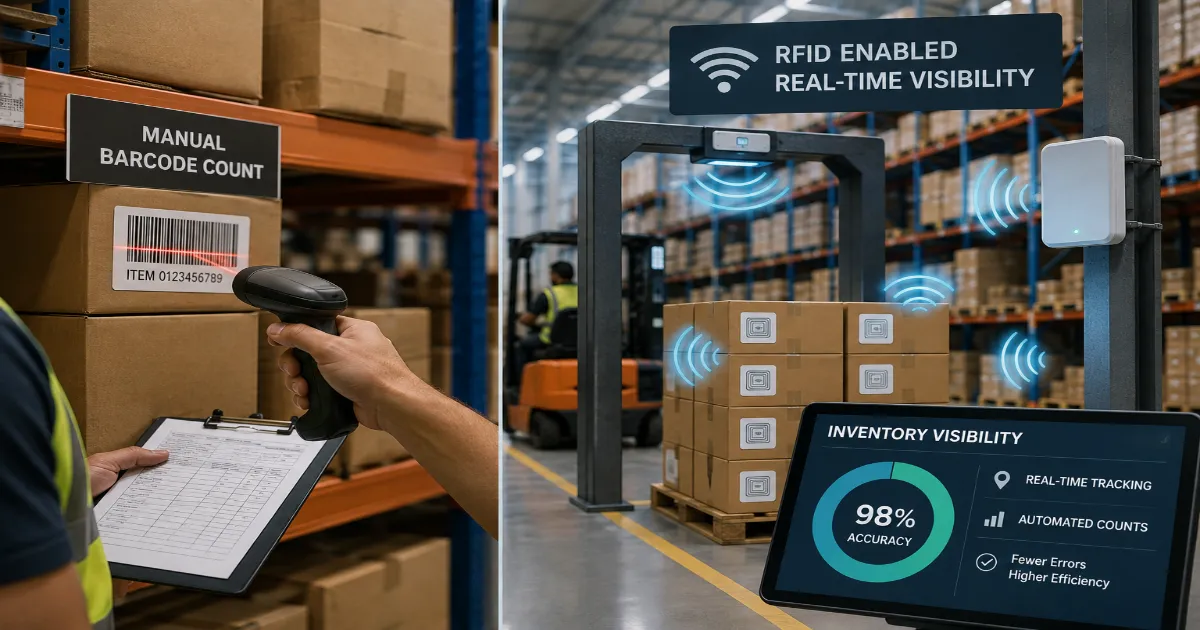
The practical difference shows up immediately on the warehouse floor. A worker doing a manual barcode count has to locate each item, find the barcode, and scan it — a process that, across thousands of SKUs, can consume hours or days and multiple staff members. An RFID-enabled cycle count can capture the same data in a fraction of the time, without unpacking boxes or repositioning inventory, because the reader is capturing dozens or hundreds of tags in the time it takes to walk an aisle.
Why Adoption Is Accelerating Now
RFID isn’t new — retailers have experimented with it for over two decades. What’s changed is the economics and the surrounding technology stack. Tag costs have fallen enough that item-level tagging is now viable for mid-margin goods, not just luxury products. Reader infrastructure has gotten cheaper and easier to deploy. And critically, RFID is no longer a standalone system — it’s increasingly woven into cloud platforms, AI-driven analytics, and existing enterprise software, which means the data it captures actually gets used instead of sitting in a silo.
That convergence is the real story of RFID in 2026. It’s not just a faster scanner — it’s becoming the sensory layer for a much larger nervous system that includes warehouse management systems (WMS), enterprise resource planning (ERP) platforms, robotics, and predictive analytics tools. When a pallet moves through a dock portal, that single tag read can trigger a chain reaction: updating inventory counts, confirming a shipment against a purchase order, adjusting replenishment forecasts, and flagging any discrepancy in near real time.
Real-World Impact: The Numbers That Matter
The operational case for RFID is easiest to understand through what it actually does to core warehouse metrics:
Inventory counting time. Manual counts are one of the most labor-intensive recurring tasks in any warehouse. RFID-enabled counting has been shown to cut that time dramatically — some implementations report reductions of 75 to 95 percent compared to manual barcode scanning, since a worker can walk a zone with a handheld reader and capture every tag in range rather than scanning items one by one.
Inventory accuracy. This is arguably the metric that matters most to operations leaders, because inaccurate inventory data cascades into stockouts, overstock, and lost sales. Traditional manual inventory processes typically land somewhere in the 65-75 percent accuracy range industry-wide. RFID implementations have pushed some retailers well past 95 percent accuracy — Uniqlo’s RFID rollout, for instance, has been cited as achieving around 97 percent inventory accuracy across its stores and warehouses.
Return on investment timeline. For warehouse-focused RFID deployments, payback periods commonly fall in the 18-24 month range, driven primarily by labor savings, reduced shrinkage, and fewer costly fulfillment errors.
Fulfillment speed and error reduction. By automating what used to require manual scanning at every touchpoint — receiving, put-away, picking, and shipping — RFID reduces the human error that creeps into high-volume operations. Fewer missed scans mean fewer short shipments, fewer mispicks, and fewer customer-facing mistakes that are expensive to fix after the fact.
Case Studies: How Major Retailers Are Actually Using RFID
Numbers on a slide are one thing; seeing how they translate into daily operations is another.
Amazon has integrated RFID with robotics across its fulfillment network, using automated tracking to move goods through high-velocity warehouse environments with minimal manual scanning. The combination reduces human error while accelerating the pace at which goods can be received, sorted, and shipped — critical in an operation where speed is the entire value proposition.
Zara uses RFID for item-level tracking across its global retail footprint, giving staff real-time visibility into exactly what’s on the shelf, in the back room, or in transit. For a fast-fashion retailer whose entire business model depends on rapidly identifying and responding to trends, that visibility isn’t a convenience — it’s core to how the company avoids both stockouts on hot items and shrinkage on slow movers.
Uniqlo has pushed RFID furthest into the customer-facing experience. Beyond the inventory accuracy gains mentioned above, the retailer has deployed RFID-powered self-checkout stations where customers place an entire basket of items into a scanning zone and get a complete itemized total in seconds, without individually scanning barcodes. That same tagging infrastructure supports Uniqlo’s omnichannel promise of ordering online and picking up in-store within 24 hours — a capability that depends entirely on the retailer knowing, with near-certainty, exactly what inventory sits where at any given moment.
Where RFID Is Headed: The 2026 Trend Lines
A few clear patterns are shaping how RFID is being deployed and extended this year.
AI-driven analytics layered on top of raw tag data. Capturing a read is only step one — the more valuable shift is systems that learn from accumulated RFID data over time, predicting inventory needs, flagging anomalies, and optimizing warehouse layout and slotting based on actual movement patterns rather than static assumptions.
Convergence with other identification and location technologies. Rather than RFID replacing barcodes outright, most large-scale 2026 deployments use a hybrid model: barcode scanning for the bulk of everyday SKUs, with RFID reserved for serialized high-value items, returnable containers, and high-friction choke points like dock doors, where the speed and simultaneous-read advantage matters most. This keeps total cost of ownership manageable while still delivering real-time visibility where it counts.
Blockchain integration for supply chain trust. In industries handling high-value or regulated goods — pharmaceuticals, luxury goods, certain food categories — RFID is increasingly paired with blockchain ledgers to create tamper-proof, immutable records of a product’s journey through the supply chain, adding an anti-counterfeiting layer on top of the tracking function.
RFID-enabled loss prevention. Beyond simple inventory counts, RFID is being used to detect unexpected item movements or discrepancies that traditional security systems might miss. It’s not a replacement for existing loss prevention infrastructure, but it adds a data layer that helps operations teams spot patterns and root causes rather than just reacting after the fact.
Streamlined, frequent cycle counting. Instead of the disruptive, labor-heavy full physical inventory that used to require closing sections of a store or warehouse, RFID is pushing organizations toward smaller, more frequent cycle counts that keep data fresh without pulling staff off other tasks.
RFID Across Different Industries
RFID’s core mechanics stay the same everywhere, but the way it gets applied shifts significantly depending on the industry.
Retail and e-commerce. This is where RFID has matured the fastest, largely because the ROI math is so direct: fewer stockouts, fewer lost sales, faster omnichannel fulfillment. Item-level tagging lets retailers know not just how many units of a SKU exist company-wide, but exactly which store, warehouse, or in-transit shipment each one sits in — the kind of granular visibility that makes buy-online-pickup-in-store and ship-from-store models actually work reliably.
Manufacturing. On a production floor, RFID is used less for finished-goods counting and more for work-in-progress tracking and component verification — confirming that the right part reaches the right assembly stage at the right time. In facilities with complex bills of materials, that verification step prevents costly downstream errors where a mismatched or missing component isn’t discovered until much later in the process.
Healthcare. Hospitals and healthcare facilities use RFID for equipment tracking — locating mobile assets like infusion pumps or wheelchairs that otherwise go missing across a large campus — as well as for supply chain integrity on high-value or regulated pharmaceuticals, where an auditable chain of custody matters as much as simple stock counts.
Logistics and third-party fulfillment. For operations moving goods on behalf of multiple clients, RFID’s dock-portal use case is especially valuable: goods can be read automatically as they cross a threshold, generating receiving and shipping confirmations without a worker manually scanning every unit, which matters enormously when throughput is the entire business model.
Reusable asset and container tracking. Beyond individual products, active RFID tags are widely used to track high-value reusable assets — pallets, totes, rolling cages, specialized containers — across a facility or a broader supply network, reducing the asset loss that happens when this kind of equipment simply walks off and is never accounted for again.
Common Challenges and Limitations
RFID’s benefits are well documented, but it isn’t a frictionless upgrade, and operations considering it should go in with clear eyes about where the difficulties tend to show up.
Upfront cost and complexity. Even with tag prices falling, a full RFID deployment involves readers, antennas, network infrastructure, software integration, and a site survey to get placement right. For smaller operations, that upfront investment can be a real barrier even when the long-term payback period looks favorable on paper.
Signal interference in dense environments. Metal shelving, liquid-heavy products, and tightly packed pallets can all degrade read accuracy, which is why blanket deployment without proper planning tends to disappoint. This is also why so many operations land on a hybrid barcode-plus-RFID model rather than ripping out barcodes entirely — some environments simply aren’t RFID-friendly without significant additional engineering.
Data overload without the right software layer. A facility running thousands of reads per hour can quickly overwhelm downstream systems if there isn’t a proper filtering and transformation layer in place. Without that layer, RFID doesn’t simplify operations — it just creates a faster stream of unfiltered noise that staff still has to make sense of manually.
Change management on the floor. Workers accustomed to manual scanning workflows need retraining, and processes built around individual barcode scans — like manually confirming each item during a pick — often need to be redesigned rather than simply automated in place. Underestimating this human and process side of the rollout is one of the more common reasons RFID projects underdeliver on their projected ROI.
Tag durability and reuse. Passive tags attached to products can be damaged, removed, or degraded by handling, temperature extremes, or exposure to moisture, which means ongoing tag replacement and quality checks are a real, recurring cost rather than a one-time setup expense.
What to Consider Before Implementing RFID
For any warehouse or retail operation weighing an RFID rollout, a few practical realities are worth planning around from day one.
Read density and environmental interference. Metal shelving, liquids, and dense stacking can all interfere with RFID signal reads, which means a proper site survey — mapping optimal reader placement, antenna configuration, and shielding needs — is essential before deployment rather than something to troubleshoot after the fact.
Software is the real work, not the hardware. A tag read by itself is just raw data. The harder engineering challenge is the mobile and edge layer that filters, buffers, and transforms that raw read into a meaningful business event — a goods receipt, an inventory adjustment, a shipping confirmation — before it ever reaches the ERP or WMS. Getting this wrong means flooding your enterprise systems with noise instead of usable signal.
Selective deployment beats blanket deployment. The organizations getting the strongest ROI in 2026 aren’t tagging everything uniformly. They’re applying RFID where it solves a specific, high-value problem — serialized goods, returnable containers, dock portals, high-shrinkage categories — and sticking with barcodes everywhere else. That selective approach keeps tag costs in check while still delivering the real-time visibility that matters most.
Integration determines the ceiling on value. RFID data is only as useful as the systems it feeds into. Warehouses that treat RFID as an isolated project, rather than integrating it tightly with WMS, ERP, and existing mobile workflows, tend to see a fraction of the potential benefit — the technology becomes a faster way to count things rather than a genuine operational transformation.
The Bottom Line
RFID has moved past the experimental phase. What was once a premium technology reserved for luxury retail or high-security asset tracking is now a mainstream operational tool, with tag costs low enough and integration pathways mature enough that mid-sized operations can realistically expect payback within two years. The technology’s real value in 2026 isn’t just faster scanning — it’s the foundation for a more connected, more predictive warehouse, where inventory data updates in near real time and feeds directly into the AI-driven forecasting and automation systems that are increasingly running modern supply chains.
For operations still relying entirely on manual barcode counts, the gap between what’s possible and what’s currently happening on the floor is only going to widen. The question for most warehouse and inventory leaders in 2026 isn’t whether RFID is worth considering — it’s which parts of the operation to tag first.


One Comment