Humanoid Robots in Manufacturing: Hype or Reality? Inside the 2026 Factory Floor
 Why Humanoid Robots in Manufacturing Are Finally Leaving the Demo Reel Behind
Real shifts at BMW, Amazon and Toyota are testing the true limits of humanoid robots in manufacturing
For years, the idea of a robot with two arms, two legs, and something resembling a human silhouette walking a factory floor felt like a concept reserved for trade-show demo reels and viral videos. In 2026, that has changed — but perhaps not in the sweeping, “robots are replacing every worker” way the headlines suggest. Humanoid robots in manufacturing have moved from research labs into real, paid, revenue-generating shifts at some of the world’s largest industrial companies. BMW, Mercedes-Benz, Amazon, GXO Logistics, and Toyota have all published verifiable deployment data. Yet alongside those milestones sits a persistent, uncomfortable question that engineers, investors, and factory managers are all asking at the same time: is this genuine industrial transformation, or is it still, largely, hype dressed up as progress?
The honest answer, based on the data available in 2026, is that it’s both — just not evenly distributed. Some tasks are genuinely production-ready. Others remain firmly in pilot-program territory, propped up by vendor engineers and generous margins for error. This article breaks down exactly where humanoid robots in manufacturing stand today, what’s real, what’s still marketing, and what factory decision-makers should actually be planning for.
The Case for Reality: What’s Actually Working
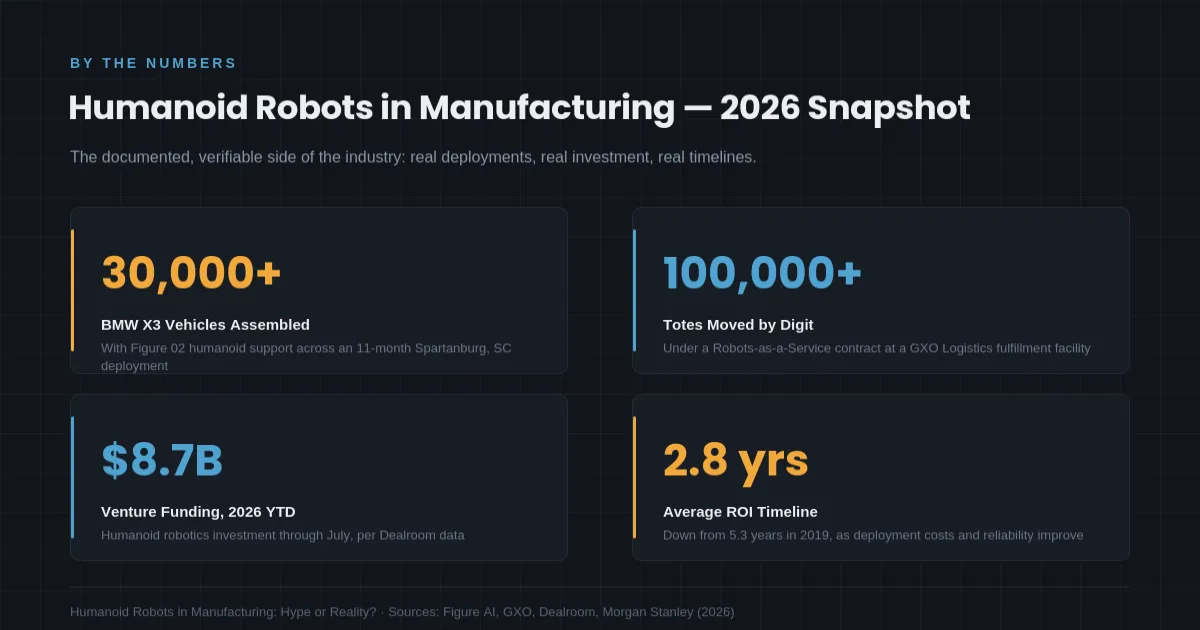
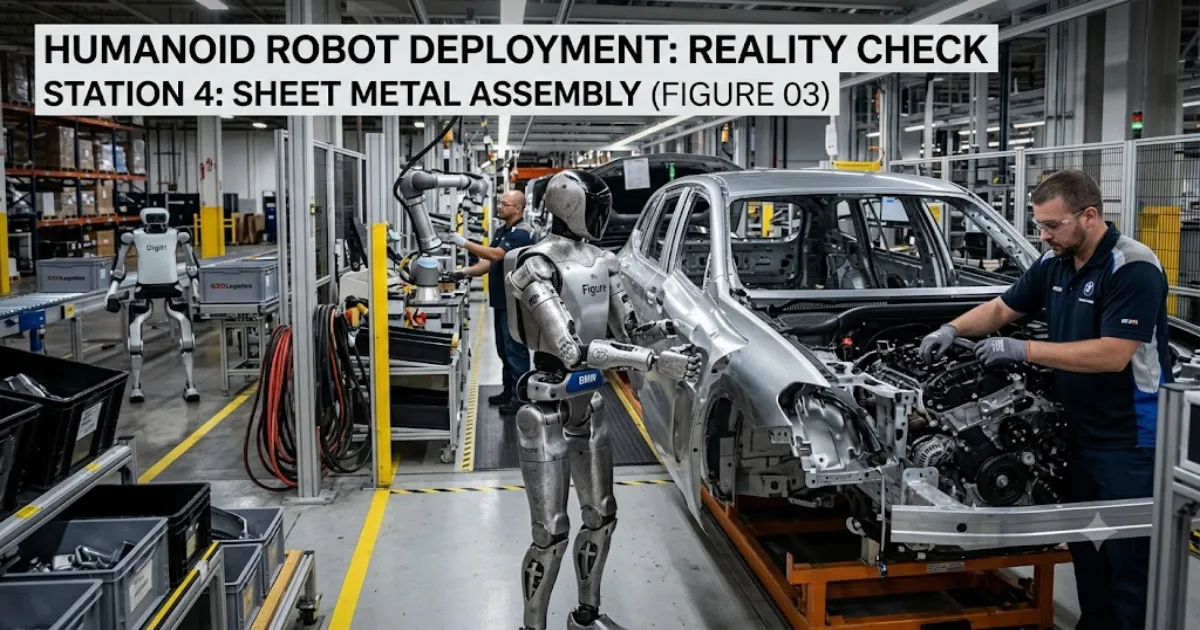
The strongest argument that humanoid robots in manufacturing have crossed from novelty into utility comes from Figure AI’s deployment at BMW’s Spartanburg, South Carolina plant. Figure 02 units spent 11 months on the line, ultimately contributing to the assembly of more than 30,000 BMW X3 vehicles and loading over 90,000 sheet metal parts across 1,250 operational hours. That is not a demo — that is a documented, sustained industrial contribution. BMW has since moved to the newer Figure 03 platform, deploying 40 units at the same facility after the successful 02 pilot, and Figure’s BotQ manufacturing facility in California is now reportedly producing one Figure 03 unit per hour, a 24-fold increase in throughput compared to just 120 days earlier.
BMW isn’t stopping at Spartanburg. The company’s AEON humanoid — its first deployment in Europe — is targeting full production on high-voltage battery assembly by the end of 2026, built around a mobile wheelbase and a self-swapping battery system designed to solve one of the sector’s biggest weaknesses: continuous shift coverage.
Elsewhere, Agility Robotics’ Digit has quietly become one of the most operationally proven humanoid platforms in the industry. It has surpassed 100,000 totes moved under a Robots-as-a-Service contract at a GXO Logistics fulfillment facility in Georgia, and completed a full year-long commercial pilot at a Toyota Motor Manufacturing facility in Ontario — one of the longer-running documented humanoid programs anywhere in the sector. Mercedes-Benz, meanwhile, is piloting Apptronik’s Apollo robot at its Digital Factory Campus, focused on transporting components to the production line and performing initial quality checks. Apollo stands 5’8″, weighs 160 pounds, and can lift up to 55 pounds — specifications chosen deliberately to match human-scale workstations without requiring any retrofitting of the factory environment itself.
The economic case is also starting to firm up. Return-on-investment timelines for humanoid deployment have reportedly dropped from around 5.3 years in 2019 to roughly 2.8 years today, and companies using AI-powered humanoid robots are reporting labor cost reductions of 22 to 28% in the first year of deployment. Safety data adds another layer to the argument: automation-heavy plants have seen exposure-related incidents — the kind associated with overhead work, under-vehicle assembly, and confined-space tasks — cut by more than half in facilities where humanoids have taken over the highest-risk stations.
Investment capital has followed the momentum. Dealroom reported $8.7 billion in humanoid robotics venture funding through July 2026 alone, with major rounds raised by Neura Robotics, Apptronik, and others, while manufacturers including Figure, Agibot, and Tesla have pushed hard to scale production volume. Unitree, the Chinese robotics manufacturer, shipped roughly 5,500 humanoid units in 2025 alone — currently the highest volume of any producer globally — with growing deployment across electronics and light manufacturing lines throughout the Asia-Pacific region. Schaeffler, the German industrial supplier, has taken an unusual dual role as both a humanoid customer and supplier, striking an agreement with Hexagon Robotics to supply rotary actuators and deploy at least 1,000 AEON humanoids across its own factories over the next seven years.
Morgan Stanley’s May 2026 forecast put a number on where this is heading: approximately 930 million humanoid robots could be in use for repetitive industrial and commercial work by 2050, with China projected to lead at over 302 million units and the United States following with roughly 77.7 million.
The Case for Hype: Where the Gap Still Shows
For every headline about robots loading sheet metal at BMW, there’s an engineer somewhere pointing out what these numbers conveniently leave out. Rodney Brooks — the co-founder of iRobot and one of the most respected names in robot perception — has publicly dismissed much of the current wave of humanoid enthusiasm as “pure fantasy thinking.” Bessemer Venture Partners offered a more measured but still cautious framing in May 2026, calling the moment robotics’ own “GPT-2.5 moment” — real capability, real scaling, but still a wide gap to the 99.9% reliability that genuine industrial-scale production demands.
That reliability gap is where most of the honest skepticism concentrates. Industrial customers typically expect 95-99% uptime from equipment on a production line. Most humanoid robots today can only operate for 30 to 90 minutes before needing a recharge or some form of intervention. Battery technology remains one of the single biggest bottlenecks in the entire category: current lithium-ion batteries generally restrict humanoid robots to somewhere between one and five hours of active use per charge, which makes genuine 24/7 industrial operation impractical without either hot-swappable battery systems or frequent, disruptive charging breaks. Agility’s Digit, for example, has documented specs of around 90 minutes of operation followed by a 9-minute fast charge — and in practice, at Amazon warehouses, it tends to operate in roughly 30-minute intervals.
Dexterity is another unresolved frontier. Current humanoid hands typically offer 10 to 16 degrees of freedom per hand — enough for picking and placing known objects in structured environments, but not enough for fine manipulation tasks like turning a screw or threading a needle. Industry analysts increasingly describe this as the “last 10% problem”: humanoids can competently handle 80-90% of a targeted task, but the remaining edge cases — unusual object shapes, unexpected obstructions, equipment malfunctions — still require a human to step in.
Safety certification is arguably even further behind than the hardware. A 60-kilogram bipedal robot working directly alongside human employees introduces real physical risk that existing industrial safety standards were never designed to address. ISO standards specifically covering humanoid robots in shared workspaces are still being developed and have not yet been finalized industry-wide. There have already been documented near-miss incidents — including at least one case of a robot stalling mid-task and blocking a warehouse aisle for hours — that illustrate how fleet management and failure-recovery protocols still lag well behind the ambition of the hardware itself.
Automotive OEMs, in particular, apply an unusually strict filter before approving any new robotic platform for production-critical stations: they typically require mean-time-to-failure (MTTF) data exceeding 50,000 hours. Published MTTF data for humanoid platforms remains sparse across the industry. Until that data exists in a form manufacturers can independently verify, most quality-driven production lines are unlikely to hand humanoids anything beyond auxiliary or lower-risk tasks.
There’s also a quieter, more structural issue: most current humanoid deployments still require significant on-site engineering support from the robot vendor, custom environment preparation, and considerable integration work before a unit can go live. The “general-purpose robot you can simply deploy in any factory out of the box” narrative that dominates investor pitch decks remains, by most independent accounts, aspirational rather than achieved.
Key Platforms to Watch
With so many companies claiming leadership in this space, it helps to separate genuine deployment activity from press-release promises. Here’s how the major humanoid platforms stack up on documented, real-world manufacturing activity as of 2026:
| Platform | Company | Documented Manufacturing Activity |
|---|---|---|
| Figure 03 | Figure AI | 40 units at BMW Spartanburg; predecessor Figure 02 helped assemble 30,000+ BMW X3 vehicles |
| Digit | Agility Robotics | 100,000+ totes moved at GXO; year-long commercial pilot at Toyota Ontario |
| Apollo | Apptronik | Piloting at Mercedes-Benz Digital Factory Campus; Robot Park facility in Austin |
| AEON | BMW / Hexagon Robotics | Targeting full production on battery assembly by end of 2026 |
| Atlas | Boston Dynamics | 2026 deployments committed to Hyundai and Google DeepMind |
| Optimus | Tesla | Fremont factory being converted toward humanoid production; not yet sold externally |
| G1 / H1 | Unitree | ~5,500 units shipped in 2025; growing use in Asia-Pacific electronics and light manufacturing |
Notably, only a small handful of these platforms — chiefly Unitree’s G1 and H1, and Agility’s Digit through an enterprise lease model — are actually available for external customers to purchase or rent today. The rest remain in closed partner programs or internal deployment, which is itself a useful signal for how far the industry still has to travel before “buying a humanoid” becomes as routine as buying a conventional industrial robot arm.
The Regional Picture
The geography of humanoid deployment is also worth watching closely, because it’s shaping up unevenly. China has moved fastest on production volume and pricing — Unitree’s aggressive cost-cutting has pushed some humanoid platforms below $20,000, a fraction of the $90,000-plus price tags that were standard just a couple of years ago. Chinese robotics financing hit roughly $7 billion across 610 deals in the first nine months of 2025 alone, a 250% year-over-year increase, reflecting how much national industrial strategy is riding on this technology. The United States, by contrast, has concentrated its efforts on fewer, deeper deployments at flagship automotive and logistics sites — BMW, Toyota, Amazon, and GXO — treating each as a proving ground rather than racing purely on unit volume. Europe has moved more cautiously still, with BMW’s AEON program representing one of the continent’s first serious industrial commitments. Morgan Stanley’s long-range forecast reflects this split, projecting China will lead in total humanoid units by 2050, with the U.S. following at a considerably smaller scale.
So, Which Is It — Hype or Reality?
The most accurate answer is that both camps are looking at the same data and emphasizing different halves of it. The reality is that humanoid robots in manufacturing have genuinely crossed a threshold — they are no longer confined to research labs or trade-show stages. Real robots are moving real parts, on real production lines, generating real revenue, at real companies with real reputations to protect. That is a meaningfully different situation than existed even two years ago.
The hype, meanwhile, lives in the implied timeline and scope. The idea that humanoids are about to become drop-in replacements for human workers across the full breadth of factory tasks — welding, high-speed stamping, fine assembly, unstructured problem-solving — is not supported by the current data. What’s actually deployment-ready in 2026 is a narrower, more specific set of use cases: ergonomic-risk assembly tasks in overhead, under-vehicle, or confined-space positions; material kitting and logistics; body-shop panel handling; EV battery module assembly; and quality-inspection assistance. These are precisely the jobs that combine high physical strain on human workers with relatively structured, repeatable environments — exactly the conditions where a bipedal, human-scale robot has a genuine structural advantage, since it can navigate existing aisles, use existing door widths, and operate at workstations built for a human body without requiring the factory to be redesigned around it.
What This Means for Manufacturers Right Now
For manufacturing executives actually weighing near-term automation decisions, the practical guidance emerging from industry analysts is consistent: don’t delay proven automation investments — cobots, fixed-arm robots, and conventional automation — while waiting for humanoids to mature. But do start establishing evaluation criteria now, so that when the first vendors reach production-ready MTTF data and formal safety certification, your organization can make a fast, data-driven decision rather than starting from zero.
There’s also a longer-term strategic insight worth noting: the factories that deploy humanoids most effectively in 2028 or 2029 are likely to be the ones that understood fixed-arm industrial robots and cobots deeply first, because much of that integration engineering knowledge transfers directly to humanoid deployment. In other words, humanoid readiness isn’t a separate skill to acquire from scratch — it’s a natural extension of automation maturity your plant may already be building today.
The Bottom Line
Humanoid robots in manufacturing are neither the imminent workforce replacement some headlines promise, nor the empty hype their harshest critics claim. They are a genuinely new category of industrial tool, still in its early operational years, proving itself task by task, plant by plant, and hour by hour of documented uptime. BMW’s 30,000-vehicle contribution and Digit’s 100,000-tote milestone are real. So too are the 90-minute battery limits, the missing safety standards, and the “last 10%” problem that still requires a human standing nearby.
The smartest response for anyone watching this space isn’t to pick a side in the hype-versus-reality debate — it’s to judge every roadmap on the same terms: repeatability, supervision requirements, runtime, safety certification, service support, and total cost of ownership, not the promised adoption date on a slide. By that standard, 2026 looks less like the year humanoid robots conquered the factory floor, and more like the year they earned the right to be taken seriously as one.
One Comment