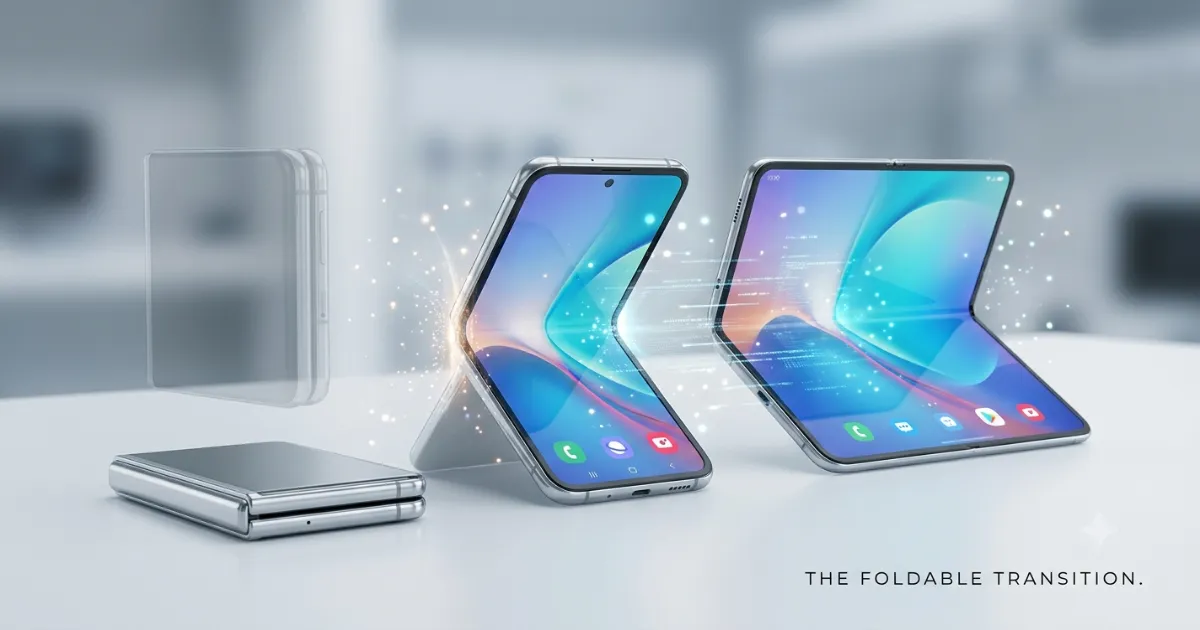
Foldable Phones: Gimmick or the Future of Smartphones?
For years, the smartphone industry appeared to have reached a design plateau.
Phones became faster, cameras became better, displays became brighter and batteries improved, but the basic formula barely changed: a rectangular slab of glass and metal that fits into a pocket.
Then came the foldable phone.
Instead of asking consumers to carry a phone and a tablet, manufacturers began trying to make one device do both jobs. A foldable could remain relatively compact when closed and transform into a much larger screen when opened.
At first, foldable phones looked more like expensive technology demonstrations than products for ordinary consumers. Early devices were thick, expensive and raised legitimate questions about durability.
But the technology has changed considerably.
Samsung has continued refining its Galaxy Z Fold and Z Flip lines, Google has pushed durability and larger displays with its Pixel Fold series, Chinese manufacturers have experimented with increasingly thin and unusual designs, and in 2026 Apple has entered the category with its first foldable iPhone.
That raises a bigger question:
Are foldable phones finally becoming the future of smartphones, or are they still an expensive gimmick looking for a problem to solve?
The answer is more complicated than either extreme.
Tech Gifts Under $50: The Ultimate 2026 Gift Guide for Anyone
What Exactly Is a Foldable Phone?
A foldable phone uses a flexible display and a mechanical hinge to allow the device to change its physical shape.
There are two major designs.
Book-style foldables
These open like a book.
When closed, they function like a conventional smartphone. When opened, they provide a much larger display that can approach the size of a small tablet.
Samsung’s Galaxy Z Fold series is one of the best-known examples. The Galaxy Z Fold7, for example, uses an 8-inch internal display and is designed around multitasking, content consumption and productivity.
Google’s Pixel 10 Pro Fold follows the same general concept, with an 8-inch internal display and a 6.4-inch outer screen.
Flip-style foldables
Flip phones take a different approach.
Instead of opening into a tablet-like screen, they fold vertically to make a conventional smartphone considerably smaller.
Samsung’s Galaxy Z Flip line is perhaps the most recognizable example.
The advantage is simple: you get a normal-sized smartphone when using it and a much smaller device when carrying it.
This design also brings back some of the personality that smartphones lost when virtually every phone became a flat rectangle.
Why Do People Want Foldable Phones?
The biggest argument for foldables is not that they look futuristic.
It is that one device can offer two different experiences.
A traditional smartphone might give you a 6.5-inch or 6.8-inch display. A book-style foldable can provide a substantially larger screen without requiring you to carry a separate tablet.
That difference becomes meaningful when you start using the device for more than messaging and social media.
1. More Screen Without Carrying a Tablet
Imagine reading a long article on a normal smartphone.
You can certainly do it, but you are constantly scrolling.
Open a foldable and the larger screen gives you more room for text, images, spreadsheets, documents and websites.
Google specifically positions its Pixel 10 Pro Fold around multitasking and entertainment, while Samsung emphasizes editing and using multiple applications on the larger display.
That is where foldables begin to make practical sense.
2. Better Multitasking
Multitasking is probably the strongest argument for book-style foldables.
Instead of switching between applications constantly, users can place multiple apps on the larger screen.
You could have:
- A browser and notes app open together
- Email alongside a document
- A video alongside messages
- A spreadsheet next to a calculator
- A map alongside a travel itinerary
This makes a foldable feel less like a larger smartphone and more like a miniature computer.
As artificial intelligence becomes more integrated into smartphones, larger displays may become even more useful because AI assistants increasingly perform tasks across multiple apps.
Counterpoint Research expects book-style foldables to represent 76% of foldable shipments in 2026, indicating that the larger-screen format is becoming particularly important in the premium segment.
3. Better Entertainment
A larger display is naturally attractive for movies, YouTube, gaming and other forms of entertainment.
A flip phone does not provide a huge unfolded screen, but a book-style foldable can.
For frequent travelers, commuters or people who consume a lot of video content, this can be a genuine advantage.
The question is whether that advantage is worth the additional price.
The Biggest Problem: Price
This is where the foldable revolution becomes difficult to justify for many consumers.
Foldable phones are still expensive.
Samsung’s 2026 Galaxy Z Fold8 starts at $1,899 in the United States, while the Z Flip8 starts at $1,199.
Google’s Pixel 10 Pro Fold launched in India at ₹172,999.
Apple’s first foldable iPhone, unveiled in September 2026, starts at $1,999 in the United States.
Those prices put foldables firmly into the premium category.
For the price of one flagship foldable, consumers can often buy a very powerful conventional smartphone and still have money left over for other devices.
That creates the central challenge for the technology:
What can a foldable do that justifies spending significantly more?
For some users, the answer is productivity.
For others, it is portability.
For many consumers, however, the answer may simply be: not enough.
Are Foldable Phones Durable?
This is perhaps the biggest question surrounding the entire category.
A conventional smartphone has a rigid display.
A foldable display has to bend thousands of times while surviving pressure, temperature changes, dust, accidental drops and everyday use.
That makes engineering considerably more complicated.
Manufacturers have therefore spent years improving hinges, flexible displays, protective layers and frames.
Samsung says its Galaxy Z Fold7 uses a redesigned Armor FlexHinge, a titanium plate layer and a 50% thicker ultra-thin glass layer compared with the previous generation.
Google has also made durability a major selling point.
The Pixel 10 Pro Fold features a gearless hinge, IP68 water and dust resistance and a display system Google says is designed to handle more than 10 years of folding.
These developments show how far the technology has progressed.
But improved durability does not eliminate the fundamental mechanical complexity.
A foldable still contains a hinge and a flexible display where a conventional smartphone does not.
That means consumers should still treat foldable phones differently from traditional phones.
The Crease Problem
There is another issue that manufacturers have spent years trying to solve:
the crease.
When a flexible screen folds repeatedly, the folding area can become visible.
Some users barely notice it.
Others find it distracting.
The crease has become something of a symbol of the foldable-phone era because it reminds consumers that they are looking at a flexible display rather than conventional glass.
Manufacturers have steadily reduced its visibility through improved hinge designs and display materials.
But eliminating the crease completely remains one of the industry’s most important design challenges.
What About Battery Life?
Foldable phones have another engineering problem: space.
A traditional smartphone has a relatively simple internal layout.
A foldable has to accommodate two display sections, a hinge mechanism and additional structural components.
At the same time, manufacturers want the device to become thinner and lighter.
That creates a difficult balancing act between:
Battery capacity + thickness + weight + durability.
Google has emphasized battery improvements with the Pixel 10 Pro Fold, claiming more than 30 hours of battery life.
But battery technology has not magically changed simply because phones can fold.
Manufacturers still have to work within the physical limitations of lithium-ion batteries.
Foldables Are Not Just About Hardware
One of the biggest differences between a good foldable and a bad foldable may not be the hinge.
It may be the software.
A large display is only useful if applications take advantage of it.
A badly optimized app can simply stretch across the larger screen without providing any meaningful benefit.
That is why manufacturers are increasingly designing software specifically around multitasking, split-screen applications, floating windows and AI-powered features.
The future of foldables therefore depends on both hardware and software.
A phone that physically opens into a tablet but behaves exactly like a normal smartphone is missing much of the point.
The Apple Effect
The biggest development in the foldable market in 2026 may be Apple’s entry.
Apple unveiled its first foldable iPhone on September 9, 2026. The device, called the iPhone Duo, opens to a 7.6-inch display and starts at $1,999 in the United States.
Apple’s entry matters for more than the number of phones it might sell.
Apple has enormous influence over smartphone design trends.
When Apple embraces a technology, consumers who previously ignored it may suddenly become interested.
That could encourage developers to optimize applications for foldable displays and push competing manufacturers to improve their own designs.
It could also accelerate investment in flexible displays, hinges and related components.
In other words, Apple does not necessarily need to dominate the foldable market to change it.
Its participation alone could help move foldables from a niche category toward the mainstream.
But Foldables Are Still a Niche
Despite all the excitement, foldables remain a small part of the overall smartphone industry.
That distinction is important.
A technology can be rapidly growing while still being far from mainstream.
Counterpoint Research expects the global average selling price of foldable smartphones to rise 18% in 2026, driven partly by a larger premium segment and Apple’s entry.
Meanwhile, India’s foldable market is also expected to grow, but remains a niche category. Counterpoint estimates more than 650,000 foldable shipments in India during 2026.
That suggests consumers are interested, but price remains a major barrier.
The Biggest Advantages of Foldable Phones
When stripped down to the essentials, foldables offer several genuine benefits.
Larger display
Book-style models can provide a tablet-like workspace without requiring a separate device.
Better multitasking
Multiple applications can be used more comfortably on a large unfolded display.
Portability
Flip phones can become considerably smaller when closed.
Innovation
Foldables are creating new possibilities for smartphone design.
Productivity
For people who work from their phones, the larger screen can be genuinely useful.
Entertainment
Videos, games, reading and browsing can benefit from additional screen space.
These are not imaginary advantages.
The technology does solve real problems.
The Biggest Disadvantages
But the drawbacks are equally real.
High prices
Foldables remain substantially more expensive than many conventional smartphones.
Mechanical complexity
A hinge introduces another component that can potentially fail.
Display concerns
Flexible screens require different construction and handling.
Weight and thickness
Although improving rapidly, some foldables remain bulkier than conventional phones.
Repair costs
Replacing a sophisticated flexible display can be expensive.
App optimization
Not every application takes full advantage of a foldable screen.
Battery compromises
Manufacturers must balance battery capacity against thickness and weight.
These limitations explain why foldables have not yet completely replaced conventional smartphones.
Are Foldable Phones a Gimmick?
If by “gimmick” we mean technology that looks impressive but provides no meaningful benefit, the answer is increasingly no.
The latest generation of foldables can provide genuine advantages in productivity, multitasking, portability and entertainment.
The technology has also matured considerably compared with the first generation.
Google, Samsung and other manufacturers are investing heavily in stronger hinges, better displays and more sophisticated software.
But if by “gimmick” we mean a technology that is not yet necessary for most smartphone users, the answer is different.
Most people do not need a foldable.
A conventional $700–$1,000 smartphone can already handle messaging, photography, social media, gaming, navigation, streaming and everyday productivity extremely well.
That makes foldables more of a premium choice than a universal upgrade.
Who Should Buy a Foldable Phone?
Foldables make the most sense for specific types of users.
Buy one if you:
- Work extensively from your phone
- Frequently multitask
- Read documents or websites on your phone
- Watch lots of videos
- Want a tablet-like screen without carrying a tablet
- Value cutting-edge hardware
- Are comfortable paying a premium
- Want a compact phone when folded
Think twice if you:
- Want the best value for money
- Frequently drop your phone
- Want the simplest possible design
- Keep phones for many years
- Cannot afford an expensive repair
- Do not use multitasking or large displays
- Prefer maximum camera and battery performance for the price
For the average consumer, a conventional flagship remains the safer choice.
Will Foldable Phones Replace Regular Smartphones?
Probably not completely.
At least not in the near future.
The smartphone market is unlikely to converge on a single design.
Instead, we may see several categories existing side by side.
Traditional smartphones will remain popular because they are simple, durable and relatively affordable.
Flip foldables will appeal to people who prioritize compactness and style.
Book-style foldables will attract productivity-focused users who want a larger screen.
And more experimental designs—including multi-fold and tri-fold devices—could push the category further toward tablet-like experiences.
Huawei has already demonstrated the direction with tri-fold devices, while other manufacturers continue experimenting with new form factors.
The future may therefore be less about replacing the smartphone and more about changing what a smartphone can become.
The Real Future of Foldable Phones
The most important question is not whether foldable phones will replace traditional smartphones.
It is whether manufacturers can solve the remaining problems.
Three developments could determine the next phase of the industry:
1. Lower prices
If foldable technology becomes affordable outside the ultra-premium market, adoption could increase dramatically.
2. Better durability
Consumers need confidence that a $1,500–$2,000 phone will survive years of normal use.
3. Better software
The larger display needs to provide more than extra pixels. Applications must actually take advantage of the additional space.
If manufacturers can solve those three problems, foldables could become much more mainstream.
Verdict: Gimmick or the Future?
Foldable phones are neither simply a gimmick nor an inevitable replacement for conventional smartphones.
They are an emerging smartphone category that has finally begun to demonstrate a practical reason for existing.
The first generation was largely about proving that a phone could fold.
The latest generation is about proving why it should.
That distinction matters.
A foldable phone can now genuinely replace some tablet use, improve multitasking and provide a different relationship between screen size and portability.
But the price, complexity and durability concerns mean conventional smartphones remain the better choice for most buyers.
The arrival of Apple’s foldable iPhone could be an important turning point. If Apple can convince millions of existing iPhone users that folding their smartphone is worth the premium, the category could move much closer to the mainstream.
For now, the most accurate verdict is simple:
Foldable phones are no longer just a gimmick. But they are not yet the future of every smartphone, either.
They may instead be the beginning of a future where the smartphone is no longer defined by a fixed rectangle.
And that could be much more important than simply having a screen that folds.
Suggested FAQ Section
Are foldable phones worth buying in 2026?
They can be worth buying for users who value multitasking, large displays and portability. However, conventional flagship phones generally offer better value for consumers who do not need a folding screen.
Do foldable phones break easily?
Modern foldables are significantly more durable than early models, with manufacturers improving hinges, protective glass and water resistance. However, their mechanical construction remains more complicated than that of conventional smartphones.
Are foldable phones the future?
Foldable phones are likely to remain an important part of the premium smartphone market. Whether they eventually become the dominant smartphone design will depend on price, durability, battery technology and software support.
What is the main disadvantage of foldable phones?
The biggest disadvantages are generally their high prices, mechanical complexity, potential repair costs and the compromises required to make a large folding display portable.
Will foldable phones replace normal phones?
Probably not completely. Traditional smartphones are likely to remain popular because of their simplicity, durability and lower cost, while foldables serve consumers who want larger screens or more compact designs.
Why are foldable phones so expensive?
Foldable phones require specialized flexible displays, hinges, structural components and additional engineering. These components and the relatively small production volumes of premium foldables contribute to higher prices.