What Is Smart Manufacturing? How Smart Factories Work, Benefits & Examples
Manufacturing is undergoing one of the biggest transformations since the introduction of automation and mass production. Factories that once depended heavily on manual inspections, paper-based records and fixed production schedules are increasingly using connected machines, sensors, artificial intelligence, robotics, cloud computing and real-time analytics.
This transformation is commonly known as smart manufacturing.
At its simplest, smart manufacturing means using connected digital technologies and data to make manufacturing operations more visible, intelligent, automated, flexible and responsive. It is closely associated with Industry 4.0, the fourth industrial revolution, where machines, software, people and business systems work together through digital connectivity. IBM describes Industry 4.0 and smart manufacturing as a digital transformation focused on real-time decision-making, productivity, flexibility and agility.
But smart manufacturing is much more than installing sensors on machines or adding robots to a factory.
A genuinely smart manufacturing operation can collect information from equipment, understand what that information means, identify problems before they become expensive failures, adjust production based on changing conditions and provide managers with actionable information in real time.
This beginner’s guide explains what smart manufacturing is, how it works, the technologies behind it, its benefits and challenges, practical examples, and how a traditional factory can begin its journey toward becoming a smart factory.
What Is Smart Manufacturing?
Smart manufacturing is a connected, data-driven approach to manufacturing in which machines, production systems, software and people work together to monitor, analyze and optimize manufacturing processes.
The central idea is simple: collect better information, understand it faster and use it to make better decisions.
Traditional manufacturing often operates through isolated systems. A machine may have its own controller, the maintenance team may maintain separate records, the production department may use another software system, and management may receive reports hours or days later.
Smart manufacturing attempts to connect these different layers.
Sensors can monitor machine temperature, vibration, pressure, speed, energy consumption and other parameters. Industrial software can collect this information. Analytics platforms can identify patterns. Artificial intelligence can detect anomalies or predict potential failures. Operators can then receive alerts and take action.
NIST describes smart manufacturing systems as adaptive systems built around cyber-physical systems and data analytics, with the potential to support real-time optimization of production and supply-chain networks.
The important word here is connected.
A machine that automatically performs a task is automated. A machine that performs the task, measures its own performance, communicates its condition and provides information that helps the production system optimize itself is part of a much smarter manufacturing environment.
Smart Manufacturing vs Traditional Manufacturing
To understand the concept, consider a simple example.
Imagine a factory operating 20 industrial motors.
In a traditional environment, technicians may inspect those motors according to a maintenance schedule. If a motor starts making unusual noise, an operator may report it. If the motor eventually fails, production stops and maintenance workers repair it.
This is largely a reactive approach.
Now imagine those same motors equipped with vibration and temperature sensors. Data is continuously collected and analyzed. The system recognizes that one motor’s vibration has gradually increased over several weeks.
Instead of waiting for failure, the maintenance team receives an alert recommending an inspection.
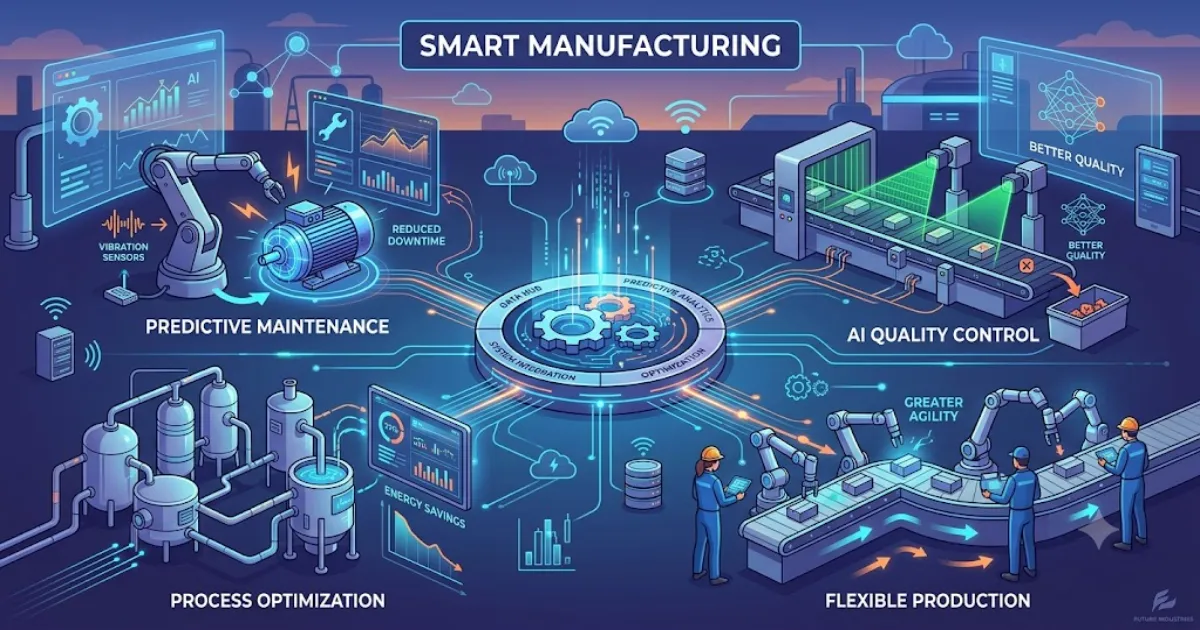
That is predictive maintenance, one of the most important applications of smart manufacturing. Predictive maintenance uses real-time condition data to identify patterns associated with potential equipment failures and allows maintenance teams to intervene strategically rather than simply waiting for breakdowns.
The difference isn’t simply that the second factory has more technology. The difference is that data has become part of the decision-making process.
How Does Smart Manufacturing Work?
Smart manufacturing typically works through a combination of several layers rather than one individual technology.
At the factory floor, machines and sensors generate data. Industrial networks transfer that information. Edge devices and software process some of the information close to where it is generated. Manufacturing execution systems and enterprise software provide operational context. Cloud platforms can store and analyze large quantities of data. Artificial intelligence and analytics turn data into insights.
The final step is action.
An alert may tell a maintenance engineer to inspect a motor. A quality system may automatically reject a defective component. A production-planning system may change the manufacturing schedule because customer demand has changed.
This creates a continuous cycle:
Sense → Connect → Analyze → Decide → Act → Learn
The cycle can become increasingly automated as a factory matures.
1. Sensors Capture Data
Sensors are the eyes and ears of a smart factory.
They can measure temperature, vibration, pressure, humidity, flow, current, speed, position and many other variables.
For example, a food-processing facility might monitor temperature throughout a production process. A pharmaceutical manufacturer could monitor environmental conditions. A machine shop could track spindle vibration and temperature.
However, sensors are only useful if their measurements are reliable. Poor-quality or incorrectly calibrated sensor data can undermine analytics and AI systems. This is particularly important because an algorithm cannot compensate for consistently bad input data.
2. Industrial Connectivity Moves the Data
The next challenge is communication.
Machines, programmable logic controllers (PLCs), sensors, robots and software systems need ways to exchange information.
This is where industrial networking and the Industrial Internet of Things (IIoT) become important.
IIoT uses connected sensors, equipment and software to collect and analyze industrial data. Modern IIoT systems are specifically designed for environments where reliability, safety and operational continuity are critical.
Connectivity can allow information from several machines to be viewed from a single operational dashboard.
3. Edge Computing Handles Time-Sensitive Information
Not every manufacturing decision should wait for data to travel to a distant cloud server.
Suppose a vision system detects a defective component moving down a production line at high speed. The decision to reject that component may need to happen almost immediately.
Edge computing allows data to be processed closer to the machine or production line.
Cloud computing remains useful for large-scale analytics, historical data and enterprise-wide visibility, while edge computing can support applications where low latency matters. IBM identifies both cloud and edge computing as important technologies in Industry 4.0 environments.
4. Analytics Turns Data Into Information
Raw data isn’t automatically useful.
A factory might generate millions of sensor readings every day, but managers don’t need to look at millions of numbers.
Analytics software searches for trends, correlations, anomalies and performance patterns.
For example, an analytics platform might discover that machine temperature rises whenever a particular production speed is exceeded.
That information could help engineers optimize the process.
5. AI Helps Predict and Optimize
Artificial intelligence and machine learning take analytics further.
AI can analyze historical and real-time information to identify patterns that may be difficult for humans to recognize manually.
Manufacturers can use AI for predictive maintenance, quality inspection, production optimization, demand forecasting and process control. Computer vision, for example, can inspect products for defects while machine-learning models can analyze equipment data to anticipate failures.
The goal isn’t necessarily to remove humans from manufacturing.
In many successful implementations, AI acts as a decision-support system while experienced engineers and operators remain responsible for interpreting recommendations and making critical decisions.
Key Technologies Behind Smart Manufacturing
Smart manufacturing is best understood as an ecosystem of technologies rather than a single product.
Industrial Internet of Things
IIoT connects industrial machines, sensors and devices so that they can collect and exchange information.
Consider a production line containing conveyors, motors, pumps and robotic arms. Instead of each asset operating as an isolated machine, IIoT can provide a connected view of their performance.
This creates the foundation for real-time monitoring and analytics.
Artificial Intelligence and Machine Learning
AI can support decisions across the factory.
For example, an AI model could examine thousands of historical machine failures and identify combinations of vibration, temperature and operating speed that commonly occur before failure.
The system could then flag similar patterns in current operations.
AI can also support automated visual inspection, where cameras examine products for scratches, incorrect assembly, dimensional problems or other defects.
Robotics and Cobots
Robots are not new to manufacturing, but smart manufacturing makes them more connected and intelligent.
Traditional industrial robots may perform repetitive operations in controlled environments. Modern systems can integrate robots with sensors, machine vision, production software and AI.
Collaborative robots, or cobots, are another development. They are designed for applications in which humans and robots can work in closer collaboration, depending on the specific safety design and application. AI is increasingly being used to support human-robot collaboration and automate repetitive or physically demanding tasks.
Cloud Computing
Cloud platforms allow manufacturers to store, process and access large amounts of operational data.
This can be particularly valuable for companies operating multiple plants.
Instead of every facility maintaining completely isolated analytics environments, a manufacturer can potentially create common dashboards and analytics capabilities across plants.
Digital Twins
A digital twin is a digital representation of a physical asset, process or system.
For example, a manufacturer could create a digital representation of a production line and use operational data to understand how the physical system behaves.
Engineers can also use simulations to evaluate proposed process changes before implementing them physically.
This can help answer questions such as:
- What happens if production speed increases by 10%?
- Where is the bottleneck?
- What happens if another machine is added?
- How might a maintenance shutdown affect production?
- Can the process be redesigned to reduce energy consumption?
Digital twins therefore move manufacturing toward experimentation and optimization using digital models before making expensive physical changes.
Manufacturing Execution Systems
A Manufacturing Execution System, or MES, helps manage and monitor production activities.
MES can connect shop-floor operations with broader business systems and provide information about production orders, materials, quality, equipment and work-in-progress.
The real value emerges when MES, machine data and enterprise systems are integrated rather than operated as isolated applications.
The Role of IT and OT Integration
One of the biggest challenges in smart manufacturing is connecting IT and OT.
IT, or information technology, typically includes business applications, databases, enterprise software and corporate networks.
OT, or operational technology, includes industrial control systems, PLCs, machines, sensors and production equipment.
Historically, these environments were often separated for good reasons. Manufacturing equipment prioritizes safety, reliability, availability and deterministic performance.
Smart manufacturing requires greater information flow between them.
For example, an ERP system may know that demand for a product has increased. The MES may know which production orders are scheduled. The factory equipment knows current machine availability. Analytics may identify the fastest production configuration.
Connecting these systems can allow the business to make decisions based on a much more complete picture.
But integration must be designed carefully because increasing connectivity can also increase cybersecurity risks.
NIST’s manufacturing cybersecurity guidance provides a risk-based approach for managing cybersecurity risks in manufacturing environments, including systems involving industrial control systems, PLCs and other manufacturing technologies.
Smart Manufacturing in Predictive Maintenance
Consider a metal manufacturing company with a CNC machine that frequently experiences unexpected spindle failures.
Each breakdown costs the company several hours of production and requires urgent maintenance.
The company installs vibration and temperature sensors on the spindle.
Over time, the system collects information about normal operating conditions and historical failures.
Machine-learning algorithms identify patterns associated with degradation.
Several days before a likely failure, the system detects abnormal behavior and alerts maintenance personnel.
Instead of waiting for the machine to fail, the company schedules maintenance during a planned production break.
The machine still requires maintenance. The technology hasn’t eliminated physical wear.
What has changed is when the maintenance occurs.
That distinction can have major economic value because maintenance is coordinated with production rather than triggered by an unexpected breakdown.
Smart Manufacturing in AI Quality Inspection
Quality inspection provides another practical example.
Suppose a factory produces thousands of components every day. Human inspectors examine products for surface defects.
Human inspection can be highly effective, but repetitive visual inspection can also be tiring, and consistency can become difficult at high production speeds.
A smart quality-control system could use industrial cameras and computer vision.
The camera captures an image of each component. AI software analyzes the image and looks for predefined defect patterns.
A defective component can be identified quickly and separated from acceptable products.
The system can also create a digital record of defect types, production batches and machine conditions.
This creates a second advantage: quality data can potentially be used to identify the cause of defects rather than merely finding them.
Smart Manufacturing in Energy Optimization
Smart manufacturing isn’t only about production speed.
Energy is a major operating cost for many factories.
Connected meters and sensors can measure electricity, gas, compressed air, steam and other utilities.
Analytics can reveal patterns such as unusually high energy consumption during particular production periods.
For example, a factory may discover that compressed-air consumption remains high even when certain production areas are idle.
Instead of guessing where the problem lies, engineers have data that can help identify inefficiencies.
AI and optimization systems can potentially go further by recommending production schedules or equipment settings that balance output, energy consumption and other operational constraints.
What Are the Benefits of Smart Manufacturing?
The benefits vary considerably by industry, plant maturity and implementation quality. Smart manufacturing should therefore not be treated as a guarantee of automatic cost savings.
However, several benefits are consistently associated with effective implementations.
Higher Productivity
Real-time monitoring can help manufacturers identify bottlenecks and reduce unnecessary downtime.
When production managers can see what is happening across the factory, they can react faster.
Better Quality
Automated inspection and process monitoring can identify defects earlier.
Instead of discovering a quality problem after an entire batch has been produced, manufacturers can potentially detect abnormal conditions much sooner.
Reduced Downtime
Predictive maintenance can help manufacturers identify developing equipment problems before catastrophic failure.
The result can be better asset availability and more predictable maintenance planning.
Greater Flexibility
Modern markets increasingly require manufacturers to produce different products, adjust volumes and respond to changing customer requirements.
Smart manufacturing can make production systems more adaptable by providing better visibility and more automated control.
Improved Decision-Making
Perhaps the most important benefit is better information.
Instead of relying entirely on experience, assumptions and delayed reports, managers can combine operational data with business information.
This can make decisions faster and more evidence-based.
Better Traceability
Digital records can help manufacturers trace materials, production batches, machine conditions and quality results.
This can be particularly valuable in industries such as pharmaceuticals, food, automotive and aerospace where traceability requirements can be demanding.
What Are the Challenges of Smart Manufacturing?
Smart manufacturing isn’t simply a matter of buying new technology.
High Initial Investment
Sensors, industrial networking, software, robotics, cybersecurity systems and integration can require substantial investment.
For smaller manufacturers, the challenge is deciding where investment will produce measurable value.
Legacy Equipment
Many factories contain machines that are decades old.
Replacing every machine isn’t realistic.
A better strategy can sometimes involve retrofitting sensors or gateways onto existing equipment and gradually integrating it into a modern data architecture.
Data Quality
More data doesn’t necessarily mean better decisions.
If sensors are poorly calibrated, data definitions are inconsistent or information is missing, analytics and AI systems can produce misleading conclusions.
Cybersecurity
A connected factory creates additional digital entry points.
A previously isolated machine may now communicate with networks, servers or cloud platforms.
That connectivity creates new cybersecurity considerations.
NIST specifically notes that smart manufacturing’s increased connectivity, wireless networks, sensors and IT integration can introduce vulnerabilities that need to be addressed without compromising reliability, performance and safety.
Skills Gap
Smart manufacturing requires people who understand both manufacturing and digital technologies.
Factories may need industrial engineers, automation specialists, data analysts, cybersecurity professionals and technicians who can work across traditional boundaries.
Employee Adoption
Technology can fail even when the technology itself works.
If operators don’t trust a predictive-maintenance alert or workers don’t understand why a new system has been introduced, adoption can suffer.
Successful smart manufacturing projects therefore involve employees early and demonstrate how technology supports their work.
Is Smart Manufacturing Only for Large Companies?
No.
One of the biggest misconceptions is that smart manufacturing requires a futuristic factory filled with expensive robots.
A small manufacturer might begin with something as straightforward as monitoring the energy consumption of a few machines.
Another company might start by digitizing maintenance records.
A third might install sensors on its most failure-prone machine.
The important question isn’t:
“How can we make our entire factory smart?”
A better question is:
“Which manufacturing problem is costing us the most money, time or quality—and can data help solve it?”
This approach reduces risk and makes it easier to demonstrate return on investment.
How to Start a Smart Manufacturing Journey
Manufacturers should generally avoid beginning with technology for technology’s sake.
Start with a business problem.
Step 1: Identify a High-Value Problem
Look for problems such as unexpected downtime, excessive scrap, quality failures, long changeover times, energy waste or production bottlenecks.
Step 2: Establish a Baseline
Before implementing technology, measure the current situation.
For example:
- How many hours of downtime occur each month?
- What is the current defect rate?
- How much scrap is generated?
- How much maintenance does the machine require?
- What is current energy consumption?
Without a baseline, it becomes difficult to prove whether a project worked.
Step 3: Start With a Pilot
Choose one production line, machine or process.
A successful pilot can demonstrate the business case before the company invests in a larger transformation.
Step 4: Improve Data Quality
Determine what information needs to be collected and whether existing sensors and systems can provide reliable data.
Step 5: Connect Systems Carefully
Create an architecture that allows machine-level information to connect with manufacturing and business applications while maintaining appropriate security controls.
Step 6: Measure Results
Track measurable outcomes such as downtime, throughput, scrap, quality, energy consumption and maintenance costs.
Step 7: Scale What Works
Once the pilot demonstrates measurable value, expand the solution to other machines, lines or facilities.
This gradual approach is often more practical than attempting a factory-wide transformation overnight.
Smart Manufacturing and the Future of Industry
The next stage of smart manufacturing is likely to involve increasingly autonomous and adaptive production systems.
AI will become more capable of interpreting complex operational data. Digital twins will become more useful for simulation and optimization. Robots will increasingly collaborate with people. Edge computing will support faster industrial decisions, while cloud platforms will provide broader enterprise-level visibility.
Generative AI may also become an important interface for industrial information.
Instead of searching through multiple dashboards, an engineer might eventually ask:
“Why did Line 4’s output fall this morning?”
An intelligent system could potentially combine machine data, maintenance records, production schedules and quality information to identify likely causes and recommend actions.
But the future of smart manufacturing will not be determined by AI alone.
Standards, cybersecurity, interoperability, workforce skills, data quality and organizational culture will be equally important. NIST’s work on smart manufacturing emphasizes standards, protocols and measurement science because connected manufacturing systems need to work reliably across different technologies and organizational boundaries.
Smart Manufacturing Is About More Than Automation
The easiest way to misunderstand smart manufacturing is to equate it with automation.
Automation asks:
“Can a machine perform this task without a person doing it manually?”
Smart manufacturing asks a broader question:
“Can the entire manufacturing system use information to make better decisions and continuously improve?”
- A robot can automate welding.
- A sensor can monitor temperature.
- An AI system can predict a failure.
- A digital twin can simulate production.
But when these technologies work together with people, manufacturing processes and business systems, they become part of a broader smart manufacturing strategy.
That is where the real transformation happens.
Final Thoughts
Smart manufacturing represents a fundamental shift from isolated, reactive production toward connected, data-driven and increasingly adaptive operations.
It combines IIoT, sensors, industrial connectivity, AI, machine learning, robotics, cloud and edge computing, analytics, digital twins and manufacturing software to create greater visibility across the production environment.
The most successful manufacturers will not necessarily be those that buy the most advanced technology. They will be the companies that identify important operational problems, collect trustworthy data, integrate systems intelligently and turn information into measurable improvements.
For a beginner, the concept can therefore be reduced to one powerful idea:
A smart factory doesn’t simply produce things—it continuously learns from how it produces them.
And that ability to sense, analyze, learn and respond is what makes smart manufacturing one of the defining technologies of the modern industrial era.
Best Indian Handicrafts for USA Home Décor Stores: Traditional Craft Meets Modern Interiors
Hybrid vs Electric in 2026: Which One Is Really Worth Your Money?
▪️▪ ▪️▪

One Comment