Hybrid vs Electric in 2026: Which One Is Really Worth Your Money?
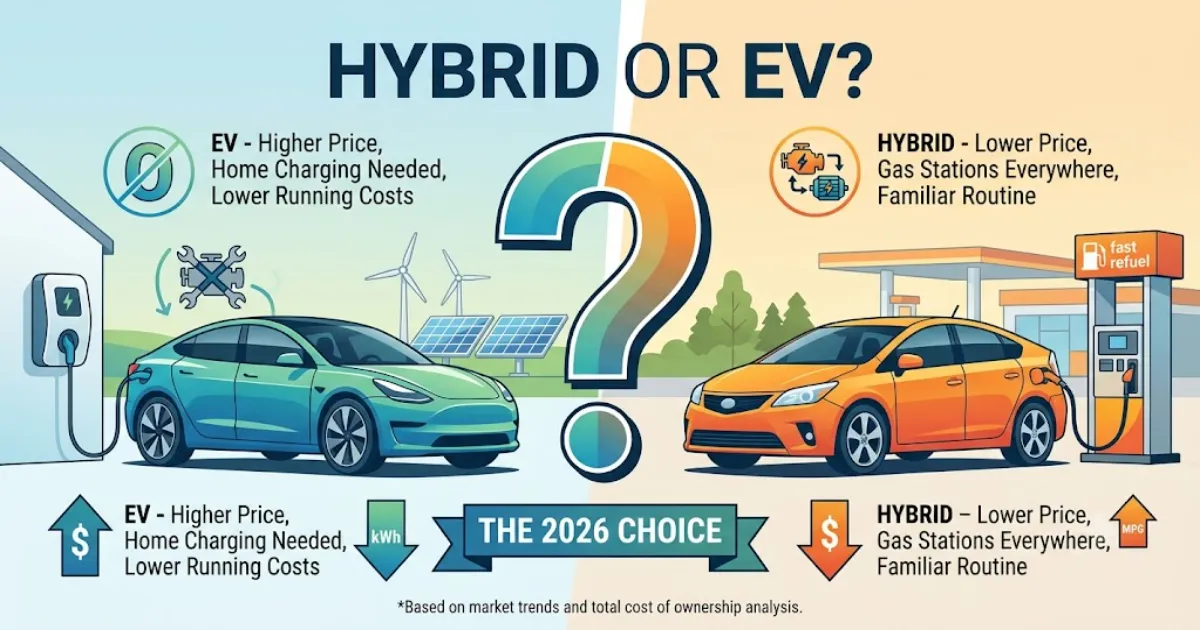 As the federal EV tax credit disappears and hybrid sales hit record highs, the hybrid vs electric decision now hinges on lifestyle as much as economics.
The Question Every Car Buyer Is Asking in 2026
A year ago, the hybrid vs electric debate had a fairly simple answer for most American shoppers: go electric, claim the $7,500 federal tax credit, and enjoy meaningfully lower running costs. That calculation no longer holds. The federal EV tax credit — along with the related used-EV credit — officially expired on September 30, 2025, and the market has responded exactly the way basic economics would predict. Hybrid sales have surged to a record 16% of U.S. light-duty vehicle sales in the second quarter of 2026, more than double the roughly 6-7% share held by battery electric vehicles over the same period.
Why RFID Just Became the Backbone of Modern Warehouses
Humanoid Robots in Manufacturing: Hype or Reality? Inside the 2026 Factory Floor
That shift isn’t just a data point for industry analysts to note in passing — it’s a signal that deserves real weight in how ordinary buyers approach the hybrid vs electric decision today. This is not a case of hybrids becoming inherently “better” than EVs on every metric. It’s a case of the incentive structure that made EVs financially competitive disappearing almost overnight, while hybrid technology has quietly matured into something genuinely low-friction. Understanding why the market moved is the first step toward understanding which option actually fits your life.
The Market Has Spoken — But Not for the Reason You’d Expect
Kelley Blue Book data shows overall U.S. new vehicle sales fell 2.2% in the first half of 2026, yet hybrid sales rose roughly 9% over the same period. Meanwhile, new EV sales dropped 27% year-over-year in the first quarter of 2026 before stabilizing somewhat. The U.S. Energy Information Administration’s own figures confirm the pattern from a different angle: 24% of new light-duty vehicles sold in Q2 2026 were electrified in some form (hybrid, battery electric, or plug-in hybrid), up from 22% a year earlier — but nearly all of that growth came from hybrids, not EVs.
The reason isn’t mysterious. Hybrids ask nothing unfamiliar of a buyer. There’s no dedicated charger to install, no change to a decades-old refueling routine, and no dependence on a still-uneven public charging network. For a market suddenly more price-sensitive and less willing to gamble on new infrastructure, that predictability matters enormously.
The Price Gap Is Now Impossible to Ignore
Here’s where the hybrid vs electric comparison gets concrete. As of 2026, the average price of a new EV sits around $62,000, while the average new hybrid comes in around $47,600 — a gap of nearly $14,400 to $15,000, even before you account for the vanished federal credit. Financed over a typical 60-month loan at 8% interest, that price difference works out to roughly $290 more per month for the EV buyer, with no tax credit left to offset it.
There’s a second, quieter shift working in hybrids’ favor: hybrid vehicle prices actually dropped by an average of 9.5% in 2024, pushing them below the average price of a comparable gas-powered vehicle for the first time in the technology’s history. Toyota — which has been building hybrids since the original Prius launched in 1997 — has had nearly three decades to bring manufacturing costs down, and it shows in current pricing across the RAV4 Hybrid, Camry Hybrid, and Corolla Hybrid lineup.
None of this means EVs have become a bad purchase across the board. It means the “EVs save you money” argument that dominated headlines two years ago now requires a lot more nuance than it used to.
Total Cost of Ownership: Where EVs Still Win
Sticker price isn’t the whole story, and this is the part of the hybrid vs electric conversation that often gets lost in tax-credit headlines. Consumer Reports research suggests electrified vehicles — EVs in particular — can still save owners somewhere between $6,000 and $10,000 over the life of the vehicle once you factor in fuel and maintenance savings compared to a gas-only car. An EV has no oil changes, no transmission fluid, no spark plugs, and dramatically fewer moving parts to wear out. Electricity, even at retail rates, is generally cheaper per mile than gasoline in most U.S. states.
The catch is that this long-term advantage only fully materializes if you keep the vehicle long enough, and if your electricity costs stay favorable — both variables that differ enormously by household. A driver who keeps a car for 3-4 years and trades it in will feel the higher upfront EV cost far more acutely than the long-run savings. A driver who keeps a vehicle for 8-10 years is in a very different position.
Five Real Buyers, Five Different Answers
The honest answer to “hybrid vs electric — which is right for me?” depends heavily on who’s asking. Here’s how the decision plays out across genuinely different lifestyles.
The Suburban Commuter — 35-mile round trip, home garage available. Someone driving a predictable 30-40 miles a day with access to a home charger is close to the ideal EV customer. A Hyundai Ioniq 5 with roughly 260-300 miles of range covers a week of commuting on a single off-peak overnight charge, and the fuel-cost savings compound quickly at that mileage. But if this same driver doesn’t have consistent access to overnight charging — renting a spot in a shared garage, for instance — a Toyota RAV4 Hybrid delivers similar around-town efficiency without ever needing to think about charging at all.
The Apartment Renter Without a Home Charger. This is where the calculation shifts hardest toward hybrids. Without guaranteed access to a Level 2 home charger, an EV owner is dependent on public charging infrastructure that remains inconsistent in coverage, reliability, and cost outside major metro cores. A Honda CR-V Hybrid or Kia Niro Hybrid sidesteps that entirely — you refuel at any gas station in five minutes, exactly as you always have. A Chevrolet Equinox EV, which starts around $34,995 and can still drop below $28,000 in states offering their own purchase incentives, is a reasonable EV option for this buyer only if a nearby fast-charging corridor genuinely fits their routine.
The Road-Tripping Family. Long highway drives are still the scenario where hybrids retain a structural advantage. A Ford Maverick Hybrid can be refueled in minutes at literally any gas station along an interstate. A Tesla Model Y — named Consumer Reports’ best EV of 2026, with a 330-mile EPA-rated range and genuinely improved reliability — handles long trips far better than EVs did even three years ago, thanks to a maturing Supercharger network. But it still requires planning charging stops around the route, and charging speed can vary meaningfully depending on which network and location you land on, especially outside the Tesla ecosystem.
The Rural or Long-Distance Buyer. For buyers in areas with limited fast-charging infrastructure — much of rural America still qualifies — a hybrid like the Kia Niro or Subaru Crosstrek Hybrid removes range anxiety from the equation entirely. Fast chargers remain sparse outside interstate corridors and metro areas, and a dead battery 40 miles from the nearest charging station is a fundamentally different problem than a dead gas tank near literally any town with a gas station.
The High-Mileage Driver — rideshare, delivery, or long commute. For someone racking up 25,000-40,000+ miles a year, the math tilts back toward EVs, assuming charging access is solved. Fuel savings scale directly with mileage, and a Tesla Model 3 or similar EV can meaningfully outpace a gas-hybrid’s running costs at high annual mileage. But the Toyota Prius remains a benchmark in this category too — its hybrid battery has a well-documented track record of lasting well over 200,000 miles with minimal degradation, making it a favorite among rideshare drivers who need low running costs without any dependency on charging infrastructure during a working shift.
Charging Infrastructure: The Reality Check
Public charging has genuinely improved since 2023, but “improved” and “solved” are different words. Charging speed, reliability, and cost still vary enormously by network and region, and a buyer without home charging access is taking on meaningfully more day-to-day friction than a hybrid owner will ever experience. This is precisely the friction hybrids were built to avoid, and it’s the single biggest reason hybrid adoption has accelerated so sharply since the tax credit disappeared — buyers are pricing in convenience, not just cash.
Cold Weather and Range: A Factor Too Often Ignored
EV range figures are EPA-rated under close-to-ideal conditions. Real-world range in cold climates can drop by 20-30% or more, driven by battery chemistry and cabin heating demands — a genuinely significant factor for buyers in northern states or mountain regions who don’t see it reflected in a dealership’s window sticker. Hybrids are far less sensitive to this effect, since the gasoline engine handles most of the heavy lifting in cold-weather driving.
Don’t Forget State and Local Incentives
While the federal EV credit is gone, it’s worth checking whether your state still offers its own purchase incentive, utility rebate, or reduced registration fee for EVs — several states have maintained or introduced their own programs specifically to offset the loss of the federal credit. These vary widely and can meaningfully change the math in the original price-gap calculation above, so this is worth ten minutes of research before ruling an EV out purely on national averages.
Resale Value and Battery Longevity
Hybrid battery longevity is no longer a question mark — it’s a settled track record. Toyota’s hybrid system, refined since 1997, routinely outlasts 150,000-200,000 miles with only gradual efficiency loss, and hybrid resale values have historically held up well precisely because buyers trust that longevity. EV battery degradation has also improved significantly with newer chemistry, but EV resale values have been more volatile, partly due to rapid technology turnover and partly due to the same tax-credit uncertainty rippling through the used market.
Insurance and Maintenance: The Overlooked Line Items
Two cost factors rarely make it into the headline hybrid vs electric comparisons, but both add up over a typical ownership period. EV insurance premiums tend to run 10-20% higher than comparable gas or hybrid vehicles in many states, largely because battery packs and specialized components are more expensive to repair or replace after an accident — a cost insurers price in regardless of how reliable the vehicle proves to be day-to-day. Hybrids, by contrast, generally insure closer to their conventional gas counterparts, since most of the drivetrain uses well-understood, widely available parts.
Maintenance tells a more mixed story. EVs skip oil changes, transmission service, and exhaust-system repairs entirely, which meaningfully lowers routine maintenance costs. But tire wear tends to be higher on EVs due to the added weight of the battery pack, and on the rare occasion a battery pack itself needs replacement outside of warranty, the bill can run into five figures. Hybrids sit in between: they still need conventional oil changes and standard servicing, but their battery packs — as Toyota’s multi-decade track record shows — rarely require replacement within a typical ownership window.
What About the Environmental Argument?
The hybrid vs electric decision isn’t purely financial for every buyer, and it’s worth addressing the environmental angle honestly rather than skipping it. A battery electric vehicle produces zero tailpipe emissions and, over its lifetime, generally results in a smaller carbon footprint than a hybrid — provided the electricity used to charge it comes from a reasonably clean grid. In regions still heavily reliant on coal-fired power, that advantage narrows, though it rarely disappears entirely. Hybrids still burn gasoline continuously, just less of it than a conventional car, so they represent a meaningful but smaller emissions reduction rather than the larger one a fully electric vehicle can offer under the right conditions. For buyers whose decision is driven primarily by environmental impact rather than cost or convenience, that distinction alone may outweigh the financial calculus laid out above.
The Analyst’s Verdict: A Framework, Not a Winner
There is no universal winner in the hybrid vs electric debate in 2026, and any article that tells you otherwise is oversimplifying a genuinely personal financial decision. What the data supports is a clearer decision framework than existed two years ago:
- Choose electric if: you have reliable home or workplace charging, your annual mileage is high enough to compound fuel savings, you live somewhere with mild winters or accept the cold-weather range hit, and you plan to keep the vehicle long enough for total-cost-of-ownership savings to outweigh the higher purchase price.
- Choose hybrid if: you don’t have guaranteed home charging, you take regular long-distance trips through areas with sparse fast-charging infrastructure, upfront price matters more than long-run savings, or you simply want zero change to how you’ve always refueled a car.
For the majority of American buyers walking into a dealership in 2026 without a strong personal reason to prioritize an EV specifically, the numbers currently favor a hybrid as the lower-risk, lower-friction choice — not because EVs got worse, but because the financial and infrastructure gap between the two options widened the moment the federal incentive disappeared. That could shift again with future policy changes or continued charging-network buildout, but for now, the hybrid vs electric decision comes down less to which technology is “better” and more to which one actually matches the way you already live.


2 Comments