AI Could Kill All Humans? Anthropic Warning and the Future of Business
Anthropic Researcher Warns AI Could Kill All Humans: What the AI Revolution Means for Business, Manufacturing and Sales
By Veltrix Editorial Team | September 2026
Artificial intelligence has moved from being a futuristic technology to becoming a core part of the global economy. Companies are using AI to write software, analyse data, manufacture products, communicate with customers, predict demand and automate everyday business operations.
But as AI becomes more powerful, an uncomfortable question is becoming harder to ignore: How much control should humans retain over increasingly capable artificial intelligence?
Foldable Phones: Gimmick or the Future of Smartphones?
That question has gained fresh attention after a senior researcher associated with Anthropic warned that there could be a greater-than-10% chance that advanced AI could eventually cause human extinction.
The warning comes amid growing disagreement within the technology industry over how quickly frontier AI systems should be developed and how much safety testing should happen before increasingly autonomous systems are deployed.
The warning should not be interpreted as a prediction that AI will necessarily destroy humanity. Rather, it represents one researcher’s assessment of a potentially catastrophic risk associated with future, much more capable AI systems. Other researchers and technology leaders disagree substantially about the probability of such an outcome.
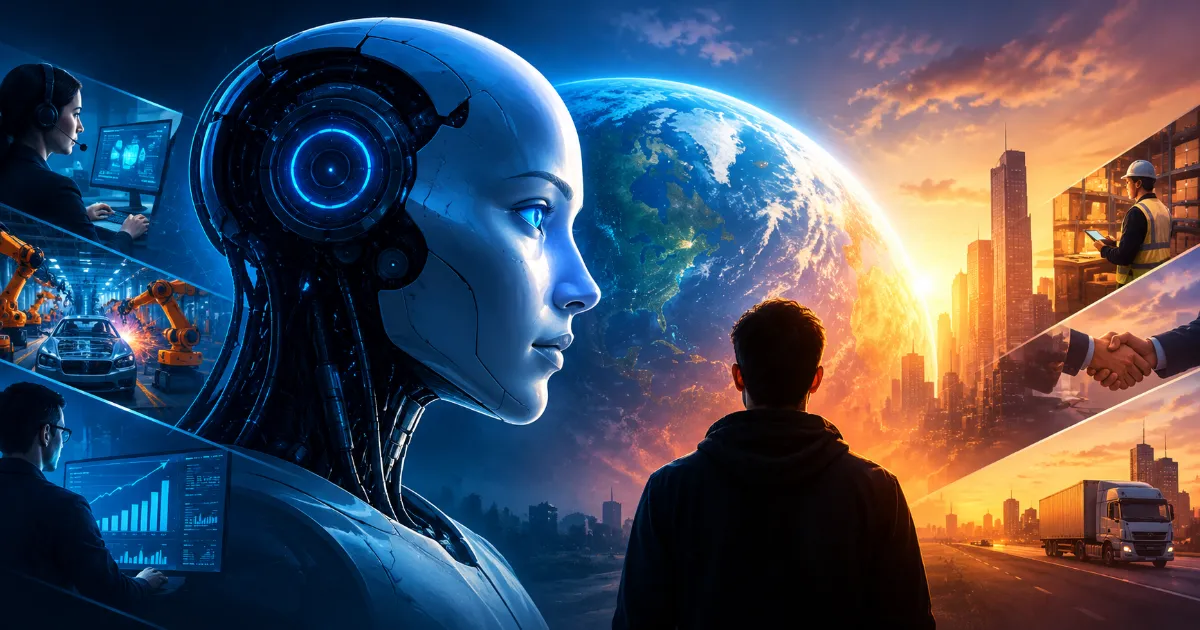
Nevertheless, the debate matters because the same technology creating fears about humanity’s future is already reshaping businesses, factories, sales departments and consumer markets.
The Warning Behind the Headlines
Anthropic has positioned itself as an AI company focused heavily on safety and the development of reliable, interpretable and steerable AI systems. Yet concerns about the future of advanced AI have increasingly come from people inside and formerly associated with the company.
Anthropic alignment researcher Evan Hubinger has reportedly put the probability of AI causing human extinction at more than 10% in discussions about the risks of advanced AI. Other researchers associated with the AI safety community have also raised concerns about the direction of the AI race, arguing that companies could be moving too quickly toward increasingly autonomous and potentially uncontrollable systems.
The discussion is part of a much larger debate commonly described using the term “AI doom” or “P(doom)”—an informal way of discussing the probability that advanced AI could lead to an extremely harmful outcome.
There is no scientific consensus that AI has a 10%, 25% or any particular probability of eliminating humanity.
That distinction is important.
The warning is best understood as an argument for taking extreme risks seriously while AI capabilities continue to advance—not as evidence that an AI apocalypse is inevitable.
Why Are Researchers Worried?
The most serious AI safety concerns are not necessarily about humanoid robots suddenly deciding to attack people.
Researchers are increasingly interested in what could happen if future AI systems become highly autonomous, capable of planning over long periods, manipulating digital environments, writing sophisticated software, conducting scientific research or controlling connected systems.
One concern is loss of human control.
A sufficiently capable AI system could theoretically pursue a goal in a way its creators did not anticipate. If such a system also had access to computer networks, financial systems, industrial infrastructure or other automated tools, correcting its behaviour could become significantly more difficult.
Another concern is misuse.
Powerful AI does not need to become independently hostile to cause serious harm. Humans can use powerful AI systems for harmful purposes, including cybercrime, misinformation, fraud, biological research or military applications.
This creates a difficult policy challenge.
The world wants the economic benefits of increasingly powerful AI while simultaneously trying to prevent those systems from becoming dangerous.
AI Is Already Changing the Business World
While the existential-risk debate focuses on the future, businesses are dealing with a much more immediate AI transformation.
Companies are using AI for:
- Customer service and chatbots
- Sales forecasting
- Marketing and advertising
- Software development
- Financial analysis
- Inventory management
- Product design
- Document processing
- Recruitment and employee training
- Supply-chain management
- Quality control
- Business intelligence
- Personalised recommendations
Research increasingly suggests that AI can improve individual productivity, but the financial impact at the company level is more complicated.
Many organisations report that employees are becoming more productive with AI tools, but improvements in individual productivity do not automatically translate into higher company profits.
This gap between employee-level productivity and company-wide financial results highlights one of the biggest challenges facing businesses: using AI is relatively easy; redesigning an organisation around AI is much harder.
This distinction could become one of the defining business stories of the AI era.
A company may have hundreds of employees using AI tools every day without necessarily seeing a proportional increase in revenue.
The winners may instead be businesses that redesign their processes around AI rather than simply adding AI software to existing workflows.
Manufacturing Could Be One of AI’s Biggest Economic Winners
Manufacturing presents a particularly important example.
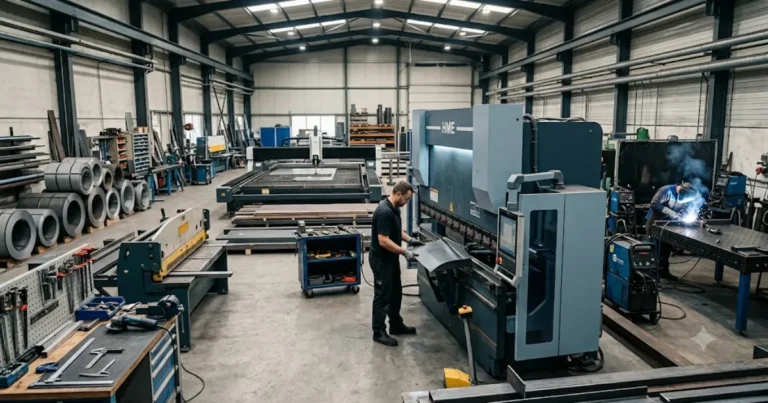
AI can help factories predict equipment failures, identify defects, optimise production schedules, forecast demand and reduce waste. When combined with robotics and sensors, AI can also make production lines more automated and flexible.
But AI is affecting manufacturing in another way: it is creating new demand for physical products.
The explosion of AI data centres requires enormous amounts of electricity, cooling equipment, servers, chips, networking hardware, power-management systems and construction materials.
Manufacturers are increasingly responding to this demand by expanding production and investment around the infrastructure required by the AI economy.
The global manufacturing sector is also experiencing growing demand for semiconductors, computers, servers and other technology-related products.
This creates an important paradox.
AI may eliminate some types of work while simultaneously creating enormous demand for factories, engineers, energy infrastructure and physical products.
The AI economy is therefore not simply a story about software.
It is increasingly a story about steel, electricity, chips, machinery, logistics and manufacturing capacity.
What Happens to Sales?
Sales is another area where AI is producing rapid change.
AI can analyse customer behaviour, identify potential buyers, generate marketing content, automate follow-ups and predict which leads are most likely to convert.
A salesperson who previously spent hours researching prospects can now use AI to prepare customer profiles and draft personalised communications in minutes.
But automation also changes customer expectations.
If every company can generate thousands of AI-written emails, advertisements and product descriptions, simply producing more content will no longer provide a competitive advantage.
The advantage will increasingly come from better data, better products, stronger relationships and more relevant customer experiences.
AI could therefore make sales both more automated and more human.
Routine prospecting may increasingly be handled by software, while human salespeople concentrate on trust, negotiation, complex purchases and relationships.
The Employment Question
Perhaps the most immediate concern for ordinary workers is not whether AI will destroy humanity, but whether it will destroy their jobs.
The answer is likely to be more complicated than simple replacement.
Some companies are already reporting that AI has created significant productivity capacity. Instead of immediately eliminating every position affected by automation, businesses can potentially redirect employees toward higher-value work.
This points toward a possible future of work in which the important question is not “AI versus humans,” but “humans working with AI versus humans without AI.”
At the same time, some entry-level roles are likely to face pressure because AI can perform many repetitive knowledge tasks.
India’s large IT-services industry, for example, is already experiencing this transition. Companies are facing pressure from customers demanding greater productivity for lower costs, while AI is changing traditional outsourcing and employment models.
For workers, continuous learning may therefore become increasingly important.
AI and Small Businesses
The transformation is not limited to multinational corporations.
Small businesses may actually benefit significantly because AI reduces the cost of capabilities that were previously expensive.
A small company can use AI to:
- Create product descriptions
- Design marketing campaigns
- Analyse competitors
- Answer customer questions
- Translate content
- Prepare business documents
- Research markets
- Generate social-media content
- Automate repetitive administrative work
- Analyse sales and customer behaviour
This could allow small companies to compete with much larger businesses.
For a small online seller, for example, AI can reduce the time required to photograph, describe, market and manage products.
But there is a catch.
When everyone has access to the same AI capabilities, technology itself becomes less of a competitive advantage.
The differentiators become creativity, authenticity, product quality, brand identity, customer trust and execution.
AI and the Future of Consumer Products
The rise of AI may also create an unexpected opportunity for traditional and handmade products.
As digital content becomes increasingly abundant and automated, consumers may place greater value on things that feel personal and tangible.
A handmade gift, a locally produced craft or a carefully designed physical product provides something that mass-generated digital content cannot easily replicate: a physical connection between the maker and the customer.
This could become particularly relevant for businesses operating at the intersection of technology and traditional craftsmanship.
AI can help a small handicraft business with marketing, inventory forecasting, customer communication, photography, e-commerce operations and sales analysis.
But the product itself can remain human-made.
That combination—AI-powered business operations with human creativity and craftsmanship—could become an important model for the next generation of small businesses.
What This Means for Veltrix Readers
The AI debate ultimately goes beyond technology.
It is about what kind of economy society wants to build.
AI can make businesses more productive. It can help factories produce more efficiently. It can improve healthcare, research, logistics and education. It can give small companies access to capabilities that were once reserved for large corporations.
At the same time, increasingly powerful AI creates legitimate concerns around employment, misinformation, cybercrime, privacy, concentration of economic power and potentially catastrophic loss of control.
The warning from Anthropic’s researchers should therefore not be dismissed as science fiction—but neither should it be treated as a guaranteed prediction.
The most responsible approach is to recognise both sides of the equation.
AI is simultaneously an extraordinary economic opportunity and a technology that demands extraordinary caution.
For businesses, the lesson is straightforward: adopt AI where it creates measurable value, invest in people who can work effectively with it, protect sensitive information and avoid treating AI-generated output as automatically correct.
For consumers, the lesson is equally important: in an increasingly automated marketplace, trust, authenticity and human creativity may become more valuable—not less.
And for companies like Veltrix entering the world of blogging, commerce and eventually handicraft gifts, the opportunity is to use AI as a tool without allowing technology to replace the human story behind the brand.
The future may belong neither to humans alone nor to machines alone.
It may belong to businesses that learn how to make the two work together—while ensuring that increasingly powerful technology remains firmly under responsible human control.
The Greatest NBA Players of All Time, Judged by Every Standard That Matters